A deliberately tongue-in-cheek title for a blog dedicated to the Napoleonic era, from the point of view of a Napoleonic history 'buff' and wargamer. "Reddition d'Ulm, 20 octobre 1805" from Wikimedia Commons
[This is a long one, so you may wish to skip the rant and background and go directly to the piccies of the game].
Trauma
There are scenes from that travesty of a fil-um Napoleon on you toobe. After he had suffered through it at the cinema, John said that I'd be traumatised if I saw it. How right that assessment.
Where do you begin with your objections and criticism? I know, from the beginning of each scene until the end.
• N and a few mates marching in a long column.
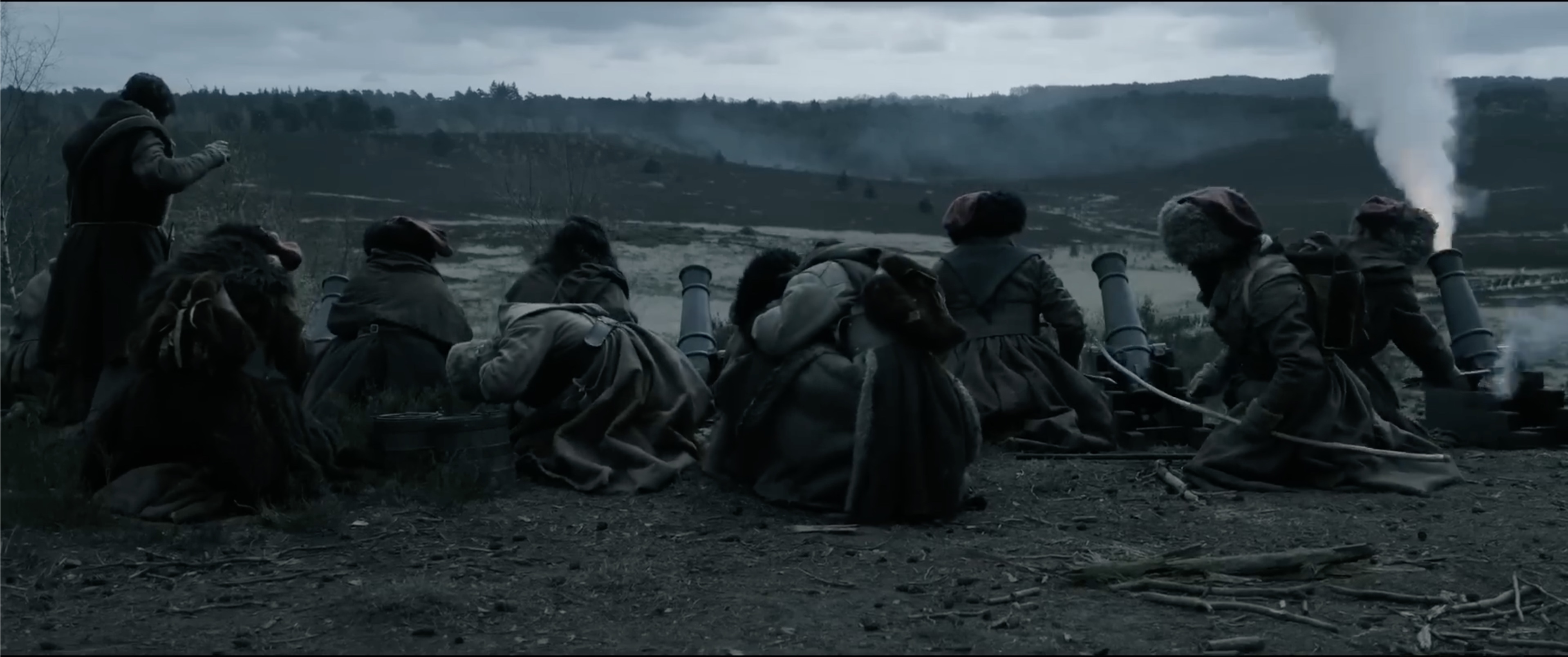
• Curses! They are cleverly ambushed by some Cossacks with their mortars, doing their best impression of Wes Studi and co. from the 1992 fil-um version of Last of the Mohicans (which messed badly with the book, but is still a most watchable film).
• Naturally you send the heavy cavalry and Guard cav. into the woods to get 'em. It worked for Maximus in Gladiator after all...
• Silly fools, walked straight into a trap and were slaughtered, their bodies strung to the trees, guerrilla war-style; a doff to the Peninsular perhaps?
• Cut to N, in his uniform as a General of the French Republic, leading the famous cavalry charge at Borodino against the Russian guns and infantry (sans redoute).
All completely accurate, sans doute, 'cause Sir Ridley has said it is.
The 600 000-strong French-allied army crossing the Niemen.
Cossacks attack with mortars.
Ambush of Guard and cuirassiers sent to deal with the Cossacks.
Napoleon charging at Borodino. Note sword in left hand.
By contrast, the French-allied army crossing the Niemen, June 1812 from Sergei Bondarchuk's War and Peace. How good does that look?!
Then, at Waterloo, we begin with some British squares with French cuirassiers swirling around which looks pretty good and a bit of a doffing to Bondarchuk's Waterloo, perhaps? We then see N revving up some line infantry, while the cuirassiers are driven back in disorder to the French lines. The British Guards form a beautiful line, which N directs his infantry to attack while he himself issues the famous order, "Prepare to charge. Charge!" The French infantry line marches towards the aforementioned British before launching into a wild charge, which the British meet with a volley and then counter-charge. Meanwhile N is coming in fast with the cavalry. In response to a request from Uxbridge(?), Wellington issues his famous "Cavalry advance!" order and the Household cavalry walk, then trot, then charge away from the British infantry line on the ridge, behind the redoubt, towards the mêlée. Meanwhile N and his cavalry in the thick of the combat between the French troops and the British guards. Observing N through his telescope, from his position on the ridge, Wellington issues his famous line "No. He can't help himself", before he is alerted by a cry of "Sir! Blucher." Looking to his right he sees a line of Prussian cavalry streaming towards the mêlée and sighs as he says "Thank God." Alarm is sound in the French ranks. N turns, sees the Prussians and then turns his mount to ride off. Fortunately, turning his head just in time to avoid the sniper of the 95th, equipped with telescopic sight, who fires at the defeated Emperor, only to blow a hole in the famous cocked hat. A fellow with side-burns and distinctive Murat looking dark hair issues Ney's line "Come, see how a Marshal of France dies!" The bloody, wild mêlée of infantry and cavalry continues as the Prussian cavalry charge into the French left. The fleeing Napoleon turns his horse and looks towards Wellington, stares for a moment, before saluting him with his sword. "The battle is mine," says the Duke. "There will be an end to the war."
Stills of the scenes from the Waterloo sequence. Note right handed Napoleon.
It gets worse and worse the more pieces of the puzzle that I see.
Telling John about my viewing of the scenes he advised:
I strongly recommend not attempting to view any more scenes unsupervised. Perhaps, someday, we shall fortify our constitutions with a suitable quantity of beverage and approach it as we might a Monty Python film, even though the Python's are far more historically accurate.
Of course a fil-um is art and not meant to be a cinematic version of an historical text.
Bondarchuk's 1970 Waterloo was an anti-war film which left the audience in no doubt, while presenting a watchable version of the Battle of Waterloo, despite (naturally) still being filled with inaccuracies to the eye of the 'specialist' and having a script that comprised of a series of memorable and enjoyable one-liners that may or may not have ever been uttered over the period of 1796–1815.
Given that, what is this film-maker trying to show to the audience? I can only guess, piecing together the 33 minutes that I have now seen—despite John's wise counsel, I watched the scenes incorporating the siege of Toulon, Coronation and Austerlitz—along with the previously viewed trailers and a few summaries and critiques.
Strangely the sniper shot striking N's hat was the best bit of those 33 minutes of my life that I will not get back. I see it as a fine piece of cinematic symbolism. The English fought against the monstrous 'ogre', to maintain the balance of power in Europe, in line with their national interest. They, along with continental allies, illustrated by the inclusion of Austrian, Russian and Prussian armies on fields of battle shown in the film, won. Yet they could not destroy the legacy and legend of *that* hat, despite sniping at it then and ever since...
What of those largely mystifyingly or hysterically inaccurate battle scenes?
I reckon that Scott realised that he did not have the resources (budget, cinematic time and extras) to produce anything close to Bondarchuk's War and Peace or Waterloo, nor did he wish to simply produce a 21st C version of those classic series/films, so he took a completely different approach.
*Different* is an understatement, but bear with me. N is almost universally accepted to be a military 'genius', or at least grand master of the military 'art'. Scott therefore decided to demonstrate this in a series of allegories and to depict Napoleon as a 'warrior', using scenes recognisable to those from various well-known films that have gone before. Hence we have a bit of Gladiator, Last of the Mohicans, Alexander, Braveheart, Gallipoli, El Cid, The Alamo, Glory, and no doubt others. N is demonstrated as a soldier, general and military strategist across time and space.
I may not be 'on the money' with this, but I reckon I am getting close. Else, Scott's intention was to stick up two fingers to the legion of devotees of the period, whether pro-, anti-, neutral or even nuanced towards the central figure.
Either way, it is artistic licence in spades. Anything that we do on the tabletop will be a more accurate representation. Mind you, I am keen to employ the tactic of a line of infantry supported by a cavalry charge. I will make a figure of N charging on horseback for the purpose.
Stress
I look forward to summer all year and love the hot weather, but it has been a particularly warm one this year. This was especially the case in February when we had three weeks with most days above 37ºC, each with three days in a row between 42ºC and around 47ºC.
Bureau of meteorology records for the York weather station for December 2023 to February 2024
Maximum temperature on our verandah on 8th February. We get 1–2 degrees hotter than the Bureau's York weather station.
This was changing at the end of the week/over the weekend and, by the time I reached Albany on Friday, the cool change had come through and I was looking for a third layer of clothing. Once I got back home mid-morning on Sunday it had reached here too, so I was freezing as the metaphoric mercury climbed to a mere 22ºC.
Cold, cold change
A cool week is forecast for this week with temperatures of only 29 to 33ºC. A bit cool for my liking, but the change is nice and it's heaps more comfortable for our animals. In addition, 'twas great to receive 12 mm of gentle, soaking rain, our first for the year (not unusual) and the only rain since a few millimetres in early November and a sharp, sudden end to the season in mid-September 2023.
Liebertwolkwitz as it couldabeen
Albany was the destination for the long-planned game of Liebertwolkwitz with the Serpentine Group. The weather was a large contributing factor to me, yet again, failing to completely finish painting the figures that I had agreed to bring to the game. That, along with working more than expected, 'commitments' to watch several speedway meetings and not switching rapidly enough to simply painting the actual, limited number of figures that I needed to bring to the game. #Sigh#.
When I got there, I 'sheepishly' pulled them out of the box in which I had transported them, but John and Mitch were really happy that I had brought them, along with some commanders. John even said that, "They are a fine looking body of Polish horse", which made me feel so great. Particularly since they pale against the masterpieces that he and Mitch paint. What a wonderful fella he is!
As always, John and Mitch had provided the vast majority of the figures and planned and set up a magnificent looking game. I, along with four others—Steve R, Steve W and Simon (who had been players at the previous games of Quatre Bras and Salamanca) and Rob (returning member to the group)—were able to simply 'waltz in', open a bev'y, assign commands, make our plans and enjoy the game!
Preparing for action.
Before I move to my report of the game, what was the Battle of Liebertwolkwitz? The entry from David Chandler's Dictionary of The Napoleonic Wars provides a simple, clear summary as he was so adept at doing:
Liebertwolkwitz, action of, 14 October 1813. As the Allied forces converged upon Leipzig, Murat, commanding 32 400 infantry, 9 800 cavalry, and 156 guns (the II, V and VIII Corps and two cavalry corps) engaged the advance guard of the Army of Bohemia to the south of the city. The morning passed in a fluctuating cavalry fight around Wachau and Markleeberg, but at 2:00 P.M. General Klenau attacked Liebertwolkwitz and captured the whole town save the church. That night the Allies evacuated the town. The action thus ended inconclusively, but it is regarded as the greatest cavalry contest of the campaign.
And, indeed of the Napoleonic Wars.
Liebertwolkwitz – Situation at 1130 Hours: October 14, 1813
The version of battle for the game was taken directly from the Age of Eagles scenario book and is a 'what if' in which all the available troops from both sides take part. Rob, Simon and I were the French-allied side, while John, Steve W. and Steve R. took the Allies. Mitch umpired and enjoyed the 'show'.
The French-allied set-up was largely determined, although we could re-arrange units and occupy the near-by towns.
Right of the French-Allied line, Victor's corps deployed (he is just visible near top left). Cröbern in foreground. Poniatowski's Poles are out of picture further to the left (north-west).
French-Allied right showing Pajol's V Cavalry Corps with Wachau at top left of picture.
The left flank of the lead elements of the Allied army that have moved to the table's edge (Cröbern in foreground). The area of the scenario map represented on the table had needed to be reduced to account for the larger scale of the game/figures.
Two close-ups of the Allied army showing Mitch's Prussian cuirassiers (3D prints and Minifigs) with John's Allied high command behind (above) and Klux's Prussian infantry of Kleist's II Corps (below) that had taken losses from defensive fire.
Close-up of French-Allied left with infantry occupying Liebertwolkwitz just visible at the centre-right. Murat (a figure that I painted in the early '80s) can just be discerned near the top left of the photo. I was just a bit excited to see him on a table again.
Overview of the table from the east. Note the wooded area in the distance occupying most of the western edge. We were concerned as it presented excellent terrain for those Cossack mortars.
Same view taken from behind the French-Allied left rear.
Overview of the French-allied line from the west. Markkleeberg in foreground.
The great cavalry battle begins. It was first blood to the Peninsular veterans.
Defeated Prussian dragoons just visible in the distance.
A breakthrough onto the Russian hussars,
...saw Milhaud's men driven back without significant loss. This was to be the order of the game. With a set of rules in which the random factor dominates, Rob's generally good rolling was matched by Steve W's poor die rolls so that the French cavalry were able to gain good victories and limited defeats.
The Prince Eugen's Russians attacked Brun's brigade of Dubreton's 4th Division of Victor's Corps in Wachau,
...but were driven back with some loss.
The great cavalry battle continued.
Rudiger's Prussian heavies headed straight for Albert's artillery of Lauriston's V Corps,
...the latter being fortunate, limbering and retiring behind infantry support (retire result in the mêlée).
Meanwhile, Milhaud's dragoons were taking on all-comers.
At the western end of the table, Steve advanced Kleist's corps steadily,
...while I occupied Markkleeberg with Poniatowski's Poles. Poniatowski had acceded to Murat's request for reinforcements and sent off Krutowski's brigade of uhlans.
Another attack on Wachau was similarly repulsed.
Milhaud's dragoons faced a brigade of Duka's Russian cuirassiers,
... coming off pretty even in the fight.
Artillery fire did what the infantry attacks had not achieved, forcing Brun's brigade out of Wachau.
But, having the initiative, the French were able to re-occupy it.
It was not Cossacks with mortars in the western woods, but a heap of Prussians, in the form of Ziethen's 11th Division.
French reinforcements had arrived as well. Augereau's infantry were sent to support the left (eastern flank), while Pacthod's Young Guard division supported Victor's troops.
Milhaud's dragoons continued on their merry romp.
Surbervie's chasseurs joined in.
Lauriston's artillery finished off Gudowich's cuirassiers.
[We can have explosions from cannon balls, just like the fil-ums.]
Perhaps the tide was turning, as Eugen's men took half of Wachau.
Only to be ejected by a French counter-attack.
Those dragoons were getting bolder and bolder (they were eventually to go too far and be broken by artillery fire).
Surbervie's men got a bit carried away,
...and were lucky to come off with a draw.
The Young Guard (heavily disguised as Middle) were ejected from Wachau.
Considering attack the best form of defence, I sent in Uminski and Tolinski's brigades against Ziethen's troops.
Tolinski's 1st Chasseurs and 3rd Uhlans, with Krutowski's brigade in the distance (fortunately it had been recently returned by the King of Naples).
Uminski's men came off decidedly second best,
...retreating to the rear with half of their saddles emptied.
Krutowski was far more successful,
...forming a guard of the right flank.
Seeing his opportunity, Pirch attacked and took Markkleeberg, eliminating Gabrowski's infantry.
Breaking through and pushing back Malachow's infantry.
Steve's best turn of the game (and his only bit of reasonable die rolls) had the French-allied left looking a bit ordinary.
It did not last. A follow-up attack against Malachow was defeated. The attempted charge by the landwehr against those limbered guns at the bottom right of the photo failed due to a poor manoeuvre roll.
Then, this attack on the Vistula legion was blown away, thanks to a timely '10' for the die roll for defensive fire.
Taking advantage, Tolinski and Krutowski's brigades charged.
Both victorious this time.
Tolinski's men breaking through and finishing off the Silesian uhlans.
Back in the centre, the great cavalry battle had petered out.
Help was arriving for the Allies in the form of Klenau's IV Corps.
Back in the west, the guns that had been largely ineffective to date, suddenly had some deadly effect (mainly in favour of the Poles).
Malachow's infantry was reduced to 'spent' in one whiff of cannon and musketry.
The 9th Landwehr paid dearly for failing to move as ordered.
The 7th Reserve suffered from effective fire as well.
As did Pirch's artillery.
The French allied troops launched general attacks around and west of Wachau, with great success.
Their successful attack (breaking two units of landwehr) leaving their flank 'hanging in the air', the Vistula Legion were fortunate to escape from subsequent artillery fire with only one base lost.
Eugen's Russians had withdrawn south of Wachau and were forced back further.
A counter-attack by one of the Russian's fresh brigades forced back Bertrand's brigade, with little loss to either side.
By now, the great cavalry battle had ceased.
Only Klenau's Austrians remained for the Allies as an effective (and completely fresh) attacking force.
This brought us to the end of eight lively turns (particularly turns 2–8) and of the game since four of the six players had to leave. We remaining two were too fatigued to pick up from the others, even to purely play out the eastern section, which would have involved switching over to someone else's command. Always a tricky thing in my experience.
While borne of necessity, stopping at this point made a lot of sense (to me at least, as a French-allied player!). The Allied forces were too worn to continue their attacks in the centre and west. Naturally, Klenau's fresh Austrians could have tried to force the issue and may likely have taken Liebertwolkwitz, although the French-allied forces had the advantages of a prepared defensive line and the cover of the town. With the power of the one who writes the history, I am happy to formulate the story that the Austrians did not have the ticker to "lose one battle in the morning and win it again in the afternoon". It makes complete sense to me that they would retire from a French-allied army that was in no state to pursue, regroup and prepare for the Battle of the Nations that was to come.
Result
We toted up the victory points for each side which comprised objectives held and losses inflicted.
Allies
Towns (Cröbern and Markkleeberg)
4 points
French-allied bases lost or damaged (2 worn x 1, 4 spent x 2, 2 eliminated x 4, 4 wrecked batteries x 1)
22 points
Total 26 points
French-Allied
Towns (Wachau and Liebertwolkwitz)
15 points
Allied bases lost or damaged (10 worn x 1, 4 spent x 2, 6 eliminated x 4, 0 wrecked batteries)
42 points
Total 57 points
Reads as a pretty clear French-Allied scenario victory to me.
HUGE thanks again to Mitch and John for organising and setting up the game. Thanks to Mitch and Gwen for hosting us and for their hospitality. Thank you to the other players who made it an enjoyable game and get together—especially to Steve R and Steve W who took so well their repeated poor die rolls and pressed on regardless.
Rules, scale and figures
Age of Eagles 2nd Edition
Figure scale 1:80–90, each stand equivalent to 320 - 360 infantry, 160 - 180 cavalry, a single battery of artillery
Ground scale 1 inch equals 60 yards (double original to allow for 1/72 figures)
Time scale 30 minutes per turn.
Figures 1/72 soft plastic figures from various manufacturers, with a few, true 25 mm Minifigs and Hinchliffe metal figures.
Reference and reading
Chandler, DG (1979) Dictionary of the Napoleonic Wars. MacMillan Publishing Co., New York. p. 249.
It has been a stop-start year on the hobby front, with plenty of other life interfering with ideas and grand plans. This has manifested in few posts on either blog, one sizeable game, albeit it a ripper back in April, and a smaller game of Nuts! using my 54 mm second world war figures (recorded on my other blog).
Things change and decisions are made. In my case this has resulted in more time available for hobby matters in the past couple of weeks which, combined with ideal weather, has seen me able to make made some serious progress with painting (by my standards at least).
The 'focus' is my army of the Duchy of Warsaw, starting with the cavalry and artillery.
Figures on the figurative 'work-bench'. About 380 cavalry, 22 guns and crew, a limber, a caisson, 24 infantry and 5 wagons.
Until now, progress has been slow.
It began back in July when Mitch mentioned that they were planning their next weekend game in Albany: Liebertwolkwitz using Age of Eagles**. It just so happened that Mitch's email letting me know this came when I had finished re-working my army lists for Jena-Auerstadt, Aspern-Essling, Wagram, Borodino, Leipzig and Waterloo. Looking at my information about Liebertwolkwitz (and knocking up an army list for myself from my Leipzig one), my eyes turned to the Poles, since much of the cavalry and some artillery were/are amongst the 3/4 completed figures that I have in mind/queue to complete. I asked him if he'd like me to paint some. He said that would help as he would have the Polish infantry covered, but would not get time to do the cavalry (nor artillery).
Hobby time came as a bit here and there during July to November. I spent the bits that I had preparing additional figures (particularly the extra artillery plus more for an eventual Borodino/Leipzig), basing and a little painting. I have far more figures on the go than will be needed for the game (plus some others besides), but part of the impetus for me is to have a completed Polish army (beginning with the cavalry and artillery) and to get some other, assorted units finished.
Fast forward to today and two bits of serendipity have come to my aid. Firstly, the game will not happen until early next year, giving me more time to work on figures. Secondly, the combination mentioned above has meant that I've been able to spend some solid time painting and am really close to getting all of the figures through my stage two; painting the base colours.
A closer photo of the middle section of the above photo in which you may be able to pick out Polish commanders, Poniatowski's guides, some other generals and the artillery caisson and limber.
Polish artillery, Krakus and 14th cuirassiers behind them and some non-Napoleonic figures that I also want to complete at the rear.
Polish chasseurs à cheval and some uhlans.
Polish 13th and 10th hussars with some more uhlans.
Other figures 'thrown in': Austrian Mészáros uhlans and grenz hussars and the French gendarmes d'ordnance.
[When I set-up the figures for the above photos I did not check/test lighting, so they look particularly 'blotchy'. They are not great in real life, but are better than the photos suggest.]
I am currently painting horses and hope to have all of them done by the end of the weekend. That should leave 'only' white and silver as the two (sizeable) colours remaining for my base coat. Black-washing and the all important and time-consuming last 10% will come after that.
I should be able to have the figures finished by the end of the year. We'll see what sort of an update I can post in two weeks or so!
**Appendix
It will be interesting to use Age of Eagles, given that they are a Napoleonic version of Fire and Fury and there are several key aspects of those rules that I am not particularly enamoured with; I do not detest them, just don’t think that they are marvellous like 'everyone else' seems to :). That said, I am more than happy to give Age of Eagles a go, especially since the main draw is a large game, beaut terrain and figures and getting together and sharing time with some fellas whose company I enjoy immensely!
This year it could have been marked by watching an eponymous film. It was not and will not be. I am boycotting that appalling film and am hoping that others will take a similar stance to add to it being a box-office flop.
I had largely made up my mind having been bemused, startled and angered by what was in the trailers. This was reinforced by watching and reading reviews written by people who actually know a bit about the man’s life and the era who went 'over the top' and saw it (sadly, there is even a bit of that in this film, I hear). My conviction has been cemented by speaking with friends who ‘went on undeterred’ and wanted to walk out a few minutes in. The highlight for them was dinner and drinks afterwards with mates and bagging the fil-um.
It is like a set of rules that you know from descriptions and reviews contain mechanics that do not appeal, or worse. I won't waste money purchasing such rules purely to make my own, similar, assessment.
It is far worse with this film and get’s worse the more that I hear about it.
I have been an amateur historian of the era since I was 12. In another six years, all going well, I will have been 'studying' the period for longer than Napoleon lived. Yet, I find new things each day that I did not previously know. Some of them quite fundamental; like being informed a few years ago that all those references to the Grand Duchy of Warsaw are not correct. It was the Duchy of Warsaw. [Speaking of which, how can you make a fit-um about N from the perspective of relations with women and not include Marie Walewska?]
I do not need to be insulted with the 'uncloaking' of a grand battery at Austerlitz. I do not need to witness the ridiculous sight of Napoleon leading a cavalry charge—I had assumed that this was some kind of dream sequence, but have been informed that it 'occurred' at Waterloo. I do not need to see the French scaling ladders at Toulon nor French cannon firing at the Pyramids. I don't want to witness the Prussians arriving on the French left at Waterloo. I will derive no edification nor entertainment from a pantomime representation of Napoleon and some puerile script.
In the ancient era one can perhaps get away with a simple, one-dimensional representation, since the extant sources are so limited. Yet it is known that there was far more to even a 'maligned' figure like Commodus. One can even depict cavalry charging through a wood especially since, despite that faux pas, that battle scene is a ripper. Not so with a person and era about which so much has been written during and since. Scott could have utilised my du Garde Peach Ladybird book 'The Story of Napoleon', the first that I read on the subject, and made a 3000% better film.
I was speaking with a good friend who had put himself through the agony of watching it. He would have left after ten minutes, but had gone to Perth (~500 km trip) to watch it with mates (not wargamers nor devotees of the period, but as good way to catch-up). He was another for whom the highlight was diner and drinks afterwards. He suggested that I would be traumatised’ if I watched it!! :)
I mentioned to him that I had heard that the uniforms are done well. He said ‘Yeah, they look great. The film is good, apart from the story and script.” I said (quipped?), “Oh, it’s like a porn film then?” He replied, “Yeah, but with Napoleon it is the audience who get f_____!"
I had come to the conclusion that it would be even worse to me than watching *that* Alexander film from 2004. Then I saw that exact comment from someone who had put themselves through seeing Scott's Napoleon.
I may buy a DVD at a discount sale and then have a ritual burning.
What a disappointment and an opportunity missed.
Thank goodness for my books, past films and wargames (however limited a representation they may be).
Addendum
I have information that sheds light on this topic. The last 15 seconds of the film were cut:
Three posts in four days; I am almost up with Stew!
Although, he is posting about doing stuff, while I am just putting up a lot of text and a few piccies. Unlike the last two, this will be a 'quickie'. Like a... (see Stew's post for a relevant analogy).
I have done a bit of impulse buying.
Now I am not posting this as one of those social media 'look what I
just bought/ate/drank kinda posts—I understand these occur
all too often, but I wouldn't know as I don't frequent them 'platforms'—it's 'cause this book might be of
interest to other's who are 'students' of the Napoleonic period (taking the widest span for that epoch).
I received an email today from Naval & Military Press promoting this little beauty. A quick look at the information and previews on their website and I was in! Around $60 (including postage by surface mail) for a hardback version that comprises 164 pages, 71 full colour uniform plates and an index and commentary in English, seemed like a good buy to me.
There are few volumes about the uniforms of the Russian army of the French Revolutionary and Napoleonic period. Certainly in English. Even fewer about the marvellous uniforms of the Potemkin reforms (1786–1796) and fewer still from the reign of Paul I (1796–1801).
The previews seem to show mainly Potemkin uniforms. There are no dates on the list of plates that is provided by Naval & Military Press in their information about the book, but I am hoping that quite a few will be of those under Paul I.
Not from this book, but detail of Knotel's representation of the Russian Potemkin uniform showing jägers, musketeers and a drummer (Wikimedia Commons).
Information about the uniforms of the latter period, which the Russian army wore in Suvorov's campaign in Italy and Switzerland, is particularly sparse and confused. Several sources indicate that they were a 'back to the future', Seven Year's War-style. While inspired by that, they were a version from the latter stages of that period, which the Prussians did not adopt, and using pretty crappy material, from what I have read.
There's a description of them in Duffy's marvellous Eagles Over the Alps, along with a few plates (but in black and white), and it does not provide sufficient detail. Viskovatov's Historical Description of the Clothing and Uniforms of the Russian Army for the period 1796–1801 (I have Mark Conrad's translation from his website and as an ebook) is limited to organisation and the plates show a more Frederickian-type uniform. The best information about the uniforms of Suvorov's army in the alpine campaign is on the website Швейцарский поход (the "Swiss campaign"), which has an in-built English language translation.
Regardless of the range of the types of uniform shown in the plates in the book, I am sure that I am gonna enjoy it and find it really useful. I'll have to wait until it arrives, in a month or three.
Having introduced my part in the Imaginations Campaign in the last post, it is time to bring you up to date with recent developments.
Oh, and haven't there been some developments...
Fortunately for us, ever the note-taker, 'our man' Jacob of Bayerische has recorded events and details, as they are known, and his reactions to them.
So, once again we'll turn to him for the story.
Having been the ruler of our nation for a yearI am deemed to have
served my apprenticeship and, in the Bayerischetradition, can assume the title of König.
This
should be a time for celebration, reflection and looking ahead, but
such feelings have been tempered by recent, dastardly events.
Back in early March, there was a call for nominations for Kaiser des Reiches. I am a strong believer in the Empire as a model
institution, an historic, voluntary grouping of like-minded nations, so I put in my oar as a candidate for the election of our next Kaiser.
The first vote, held on 25th March 1803, was a close call. There was a three-way tie between Frederick Franz, The Elector of Kaiserliche, Emil, Prince Elector of Hesse and Jacob I Kurfürst of Bayerische.
This lead to a second ballot of the Electors, held on 1st April. The votes came out in favour of Franz-Ferdinand. His coronation was set for 1st May in the Kaiserliche capitol.
While I was disappointed at being overlooked, I had been privileged to be part of a process, conducted openly, democratically and without conflict that serves as a model to other, less enlightened nations.
I accepted the vote of the Electors and was readying myself to travel to the Kaiserliche capitol to be part of the joy and celebration of Franz Ferdinand’s coronation. Then I received shocking news. On 27th April, an attempt had been made on the life of the Kaiser-elect!
Since then, I have been clamouring for news, confirmation and insight into these, it would appear, tragic events. Oh tragedy and calamity; I have been told indirectly, by Kardeef Master of Dahara and more recently Fuddland's Foreign Minister, that Ferdinand has been assassinated! Can this be true? I have sent ‘my best men’ to determine the veracity of this news and, if true, who enacted this dastardly act. They are yet to report back to me.
Not only our dear friend Franz Ferdinand, but the very institution of the Empire has been attacked. Its important, crucial position as a beacon of enlightenment for the world and as a strong
rock for the one true Faith has been challenged.
This heinous crime cannot go unpunished! Once the perpetrator(s) has been determined I will be seeking redress. I would hope that this can be achieved by peaceful means and legal processes, but I, and my subjects, are prepare to fight for what is right.
This terrible news has unsettled me greatly. I have lost a friend and brother ruler in the Empire. There is a void and likely an Empire without its elected leader.
König Jacob I von Bayerische, Kurfüst des Reiches Schloß Maximilian, Zwettei, 23rd June 1803
Additional
A comment from Richard below brought to mind the marvellous scene in I Clavdivs— but then they were all marvellous, weren't they?—between King Herod and Emperor Claudius:
True perhaps.
Or is it better to have trust and to be trustworthy? It certainly works better in Diplomacy the game, from my experience. We'll have to see how it plays out here and how young Jacob deals with it.
In June last year I was chuffed when I was asked by Joe Fisher (no relation) whether I'd be interested in joining the Napoleonic-era-inspired imaginations campaign that he had recently commenced. This is the fourth such campaign that he has run and he has noted that "...I do think it my last". Never say never Joe!
This fact/thought just added to my feeling of 'specialness' to be asked, as an outsider and relative unknown, to join in the campaign of a long-standing group of friends/wargamers. Having double-checked with Joe, to ensure that I could fulfill the commitments, I was 'in'!
I was duly given control of the small Kingdom of Bayerische, a member state of the Empire.
The campaign began in 1800 (2020) and takes place in 'real time', so that a day in our time is a day in the campaign. Hence, today is the 21st June 1803. I will am playing as a map player, so that any combats that my forces get involved in will be resolved on the table top by Joe and others.
Even with this limited role it
has taken a while for me to get a sense of who is who, what is what and what the @#%$ is going on!
As I said in recent correspondence with Joe, I honestly, really do not know what is going on, but I see that as part of the fun. This is due partly to confusion on my part and, I think and hope, a bit of deliberate obfuscation by him. A contributing factor was also that I had not put sufficient effort into my ‘homework’ for the campaign—something that I corrected to some extent over the past weekend.
Joes is doing a marvellous job. He puts in loads of time and effort to keep it going, to make it an enjoyable and challenging campaign and, especially, one that is free-flowing, giving the players as much license as possible while keeping us to task.
I'll turn over to Kurfürst Jacob I von Bayerische to provide some recent historical background.
Like
Karl XII of Sweden, whose life I have studied in depth, the death last year of König Rolf II, my
beloved Father, plunged me, ahead of expectation, into the role for which I had been
prepared over the 28 years of my life so far. Fortunately my dear Father's illness was short
and He died 'quietly and peacefully', as the history will record it—and
was the veritable truth for He and his family around Him. He has been a crucial mentor
to me and has afforded me the widest and deepest education that our
small kingdom could provide.
My Father lead our country through a period of stability and progress,
encouraging the new enlightenment enquiry and ideas, while holding firm
to our one, true Catholic Faith. It was His belief and modus
operandi that, as a small kingdom, Bayerische should keep to itself,
maintain peaceful relations with neighbours, but not engage in any
'grand escapades', as he termed them. "Jacob, I am not an isolationist,
but a realist," He told me on several occasions. This was so true.
He strongly held to Bayerische's position as a member of the Empire, but was not inclined to join in 'Imperial military ventures' as He put them. Therefore, in the spring of 1802, He went against the Electoral Council, refused to send troops to assist Konnigliche & Kaiserliche in the campaign against Dahara and even closed our borders to all foreign troop movement. This action added a distinct coolness to relations with Brunswick, Hanover and Hesse. König Rolf stressed to me that it was essential to ensure the primacy of Bayerische's national interest in all matters of diplomacy.
Yet He was far from being isolationist.
He instituted a ship building programme to develop our small fleet, establishing
the colony of Gewürzinseln, a group of islands south of the equator
renowned for the production of spices. This brought expanded trade and wealth to our nation and has lead to our new national dish, a spicy mutton stew, which goes down a treat with any of the beers for which we are famous. A dark, malty ale is a favourite of mine.
My
Father's interest in modern enquiry and working to improve the wealth
of our country and the knowledge of its citizens was never in such
evidence as when, in April 1802, He founded our first university. I will
ensure its completion and the development of a other centres of
learning for the benefit of our brightest minds and of our nation. One of my first acts was to have Our Government look into other public works—expanded roads and a possible system to remove
sewerage from our cities—that will continue the work
begun by my Father. It
seems that we have some knowledge to re-learn from the ancients.
After
a period of national mourning, I have begun a campaign of outreach to
our neighbours and fellow rulers of the nation states that comprise the
Empire. This began, on 15th October 1802, with a festival to celebrate my coronation. This comprised a week-long series of balls, fêtes and plays to entertain the visiting rulers, as well as time for meetings of state with our esteemed guests. We were pleased to welcome Princes of Hesse and Nassau, the ambassador from the Empire's council, the Queen of Konigliche and the King of Orbajosa. It was a marvellous week of joyous celebration, show-casing Bayerische and honouring the enduring friendship of our realms and peoples.
I
look forward to serving our country, to continuing on a path of stability and progress and to
continued friendly relations with our neighbours and fellow members of
the Empire.
Kurfürst Jacob I von Bayerische Schloß Maximilian, Zwettei, 25th April 1803




.jpg)
