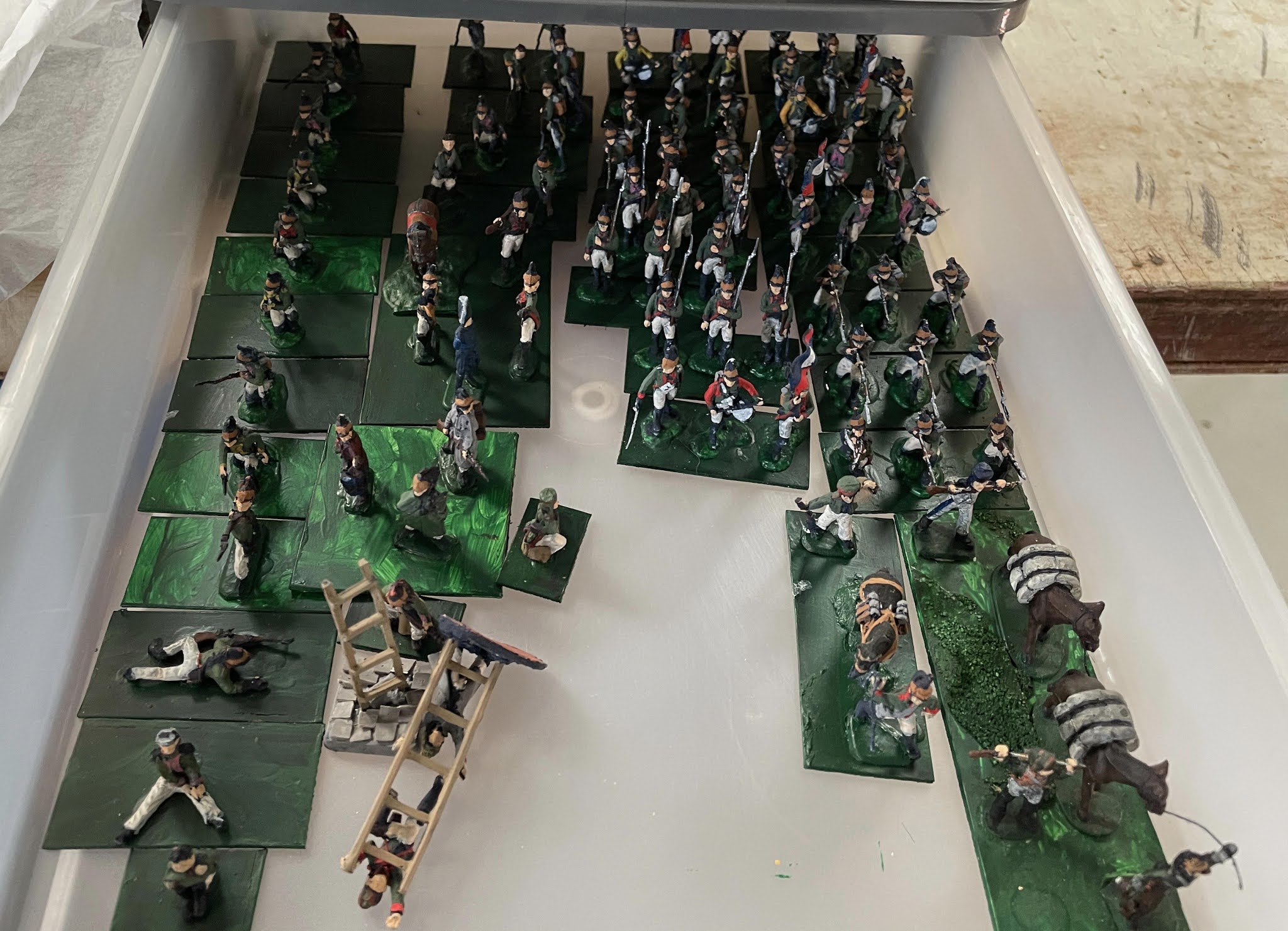
Showing posts with label 1/72. Show all posts

Thursday, 24 June 2021

Developing the love of two

French 9e cuirassiers at two scales.
A few comments on my recent 'update' post lead me to check when I first purchased some 2 mm figures. It was back in the mid-2000s. I think that I was looking at Irregular Miniature's website and happened to click on the 2 mm section. "What a marvellous idea", I thought. Wouldn't it be fun to set up a wargame at such a small scale, perhaps even on the tray at the back of an aeroplane seat?!

So, I duly ordered a few figures (French and Austrian army packs) to see them up close and what I could make of them. I liked them immediately. I was astounded at the amount of detail on something so small and also the huge scope for interpretation and adaptability of the figures. 

Some photos below taken by my non-wargaming, but camera savvy friend Chris G. showing how amazing these little fellas are.

Photos to illustrate that they can look like something (c/-  Chris G.; finger and pencil for scale).

A couple of years or so later I had sufficient figures painted, or somewhat painted, to try out a game. I had found a free set called "2 by 2 Napoleonics" on the web and Stephen N. was interested (crazy) enough to have a go.

Below are some low-resolution photos of the first try with 2 x 2 Napoleonics in May 2008. You'll see from the photos and those that follow (all c/- Stephen) that I was using the bases 'as was', stuck in my paradigm of battalion/regimental scale.

First game of 2 by 2 Napoleonics

Fiddly to handle as single playing pieces.

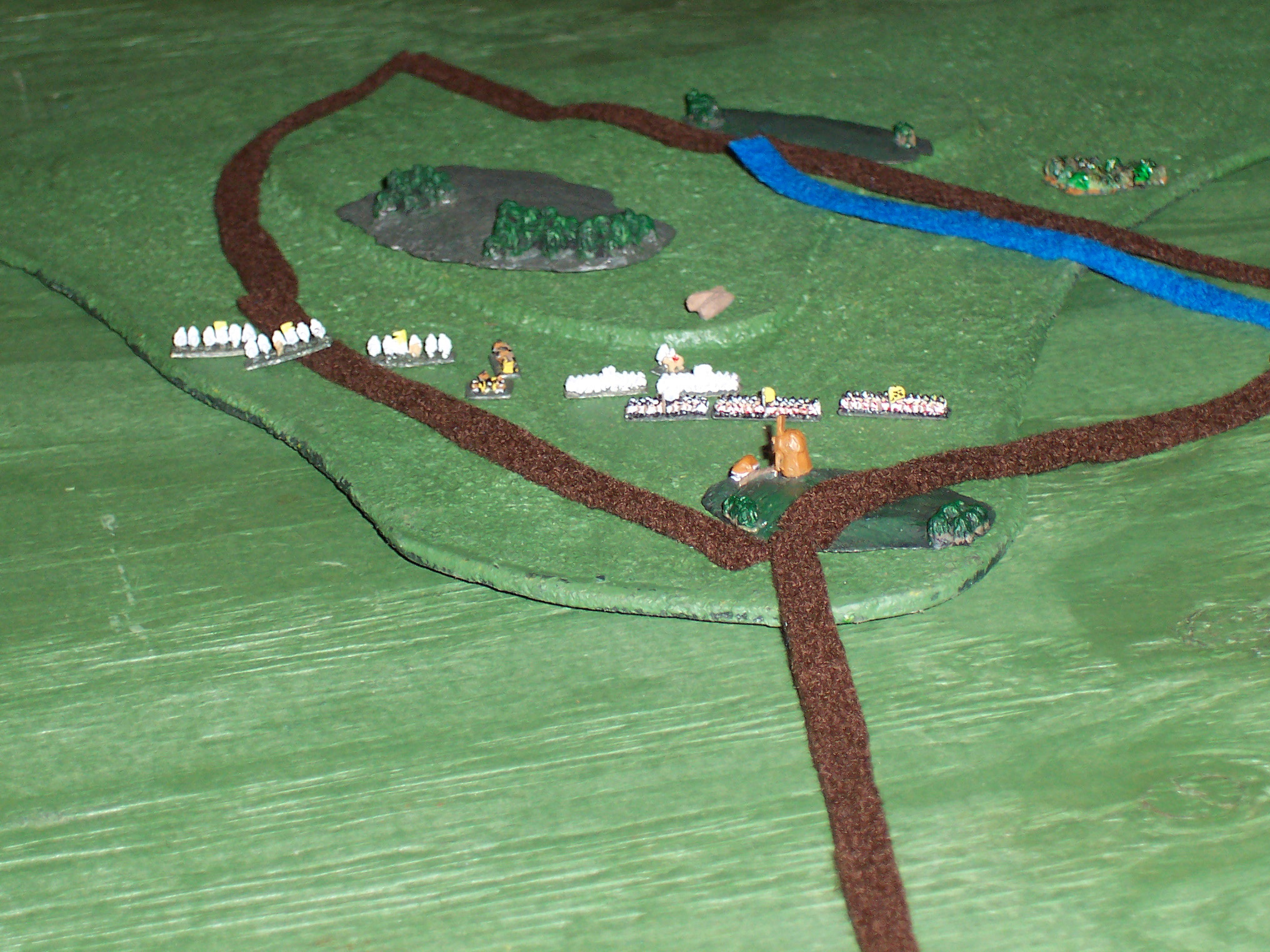
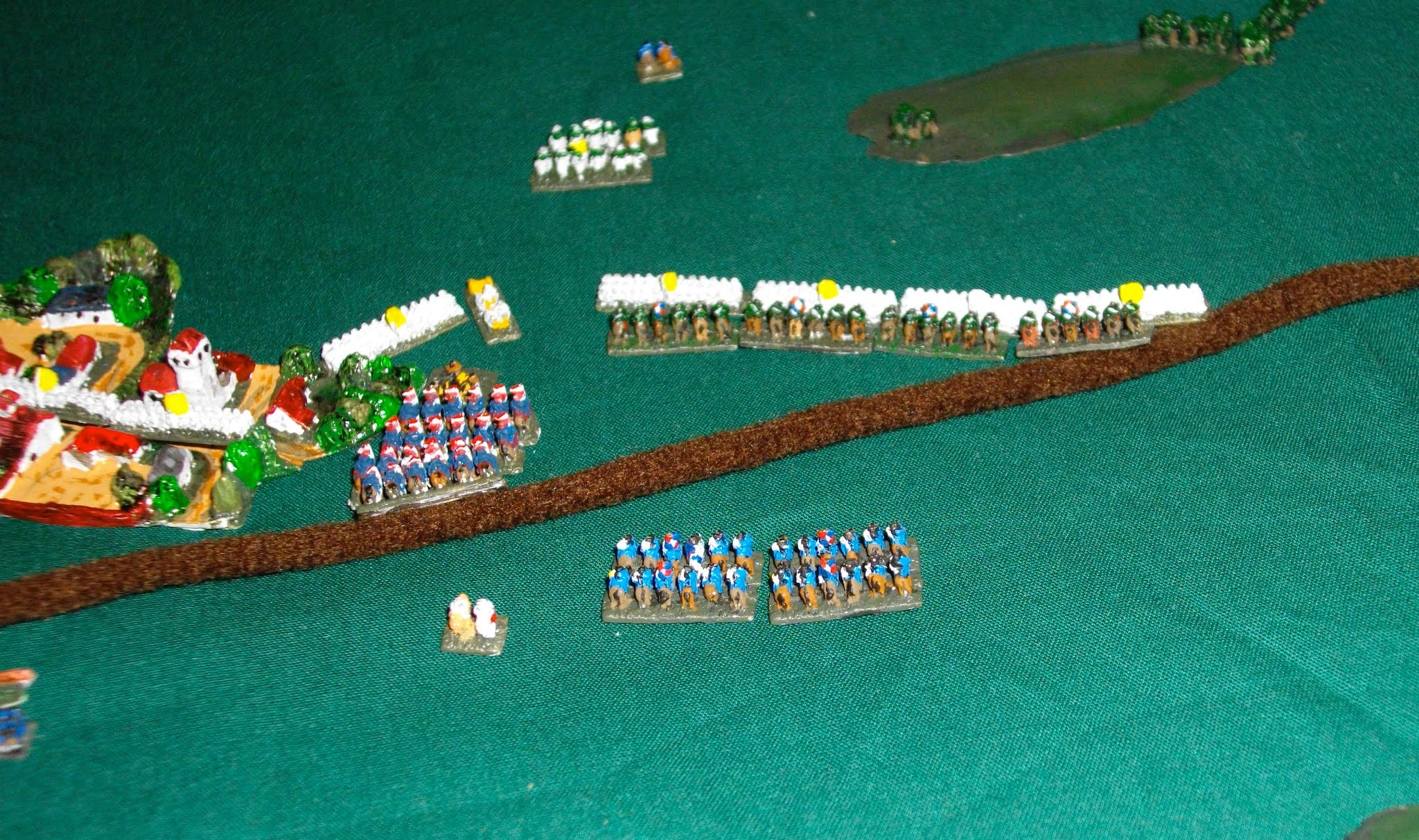
Despite the fiddliness, we both had a bit of fun and so were prepared to try them again. Two more games followed, in June 2008 and April 2009. I had added a bit more terrain and a few more figures as we went along. We adapted and adjusted the rules to try to make them work better but, in the end, decided that they were not up to scratch. There was a pause in the 2 mm 'experiment'.

Second game of 2 by 2 Napoleonics; now with felt roads, fields and rivers!

Still using single playing pieces.


Third game, now on felt mat.

Further thinking, discussions and exposure to Baccus' Polemos rules (ostensibly for 6 mm figures) brought me to basing as a regiment, brigade or division, which I duly did. Other projects and activities took precedence, so the 2 mm figures remained incomplete, with only a few French ready for use.

Below are some photos of my completed French in 2011 based as larger formations.
The French re-based ostensibly as regiments, but easily scaled to brigades or divisions.
Left to right: two line infantry regiments and a légère to right
Left to right: the two line infantry regiments and légère with artillery battery and limbers to right

Left to right: those 9e cuirassiers again, Polish Guard lancers, then line chasseurs.
Left to right: the Polish Guard lancers and line chasseurs once more with 5e hussars at right.

Advance another few years and they are back, 'bigger' than ever, as part of my desire to work at multiple scales, hopefully 'concurrently'. I have a sizeable Austrian force in my painting sights and, once they are done, there are some part-completed French to add to that force. I am flexible in how I consider my bases (regiments, brigades or divisions) for painting any little details/colour on the figures. The scale affords plenty of latitude!

Wednesday, 23 June 2021

Progress various

Early Austrians in 1/72 and a more generic version in 2 mm scale are the figures currently getting attention from the brushes chez moi. I recently moved proceedings inside the house as night-time temps have been consistently just a few degrees (celsius, of course).

It has been kinder steps with these Austrians, but they are coming along.

It has turned d@mned cold lately, it don't get much lower here.

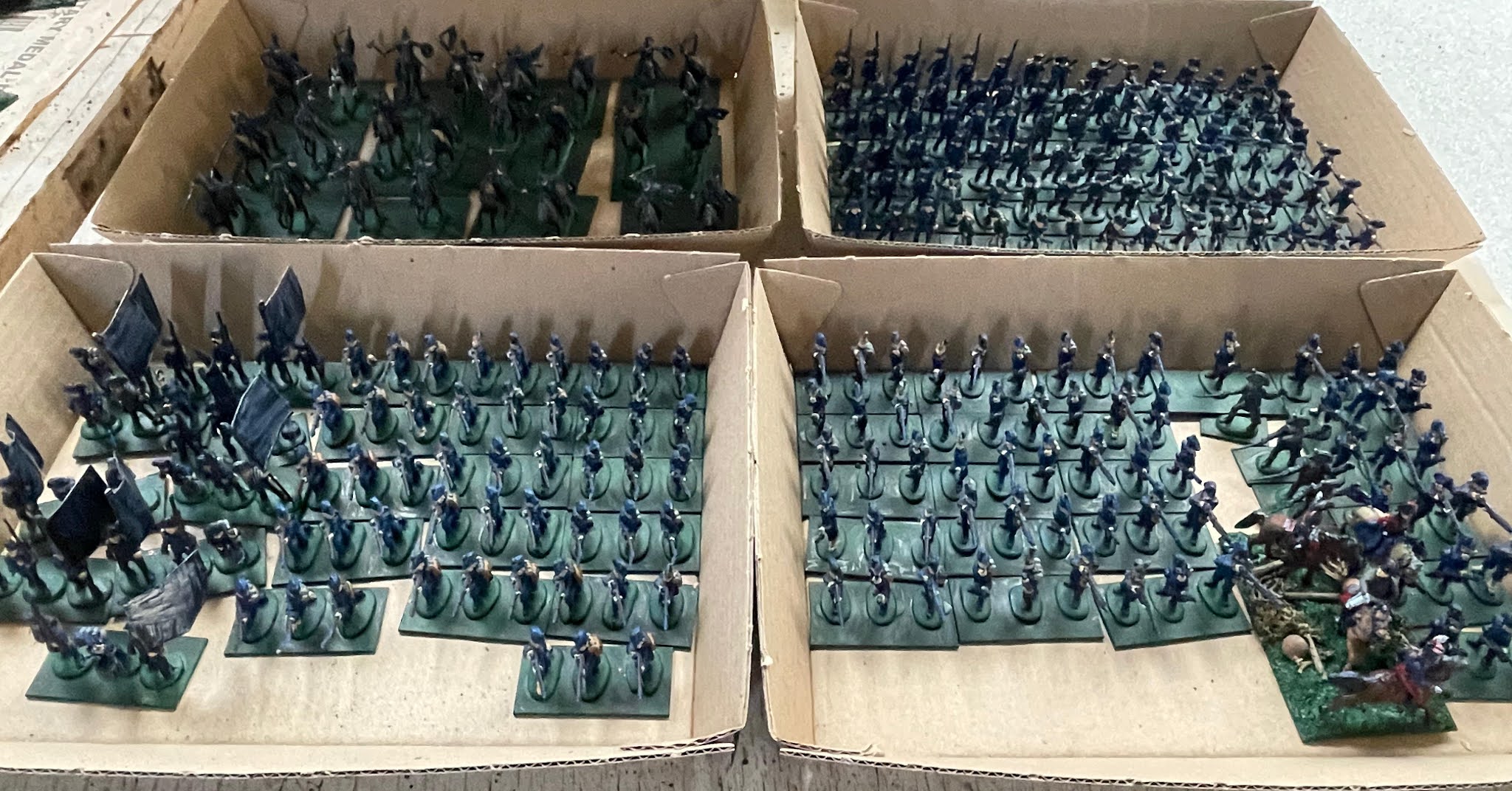
Now that I have completed faces, packs and muskets on the above 216 infantry (and a bit more on their 2 mm counterparts), I am ready to move to the facings, white uniforms and white/blue trousers (a couple of Hungarian regts being amongst them), so will also pick up on the early French that have been waiting patiently for some months!

Early French, patiently waiting their turn for some more colour.

The next four of my '21 Napoleons' are a bit more advanced and will be progressed to completion, with guides and consular guard in tow.

Consular Guard, Guides de Bonaparte and three of my next 21 Napoleons.

Closer look at four of my next 21 Napoleons, which are a bit more advanced.

I also have some figures for later years of the Napoleonic era that will get additions when I have some of an appropriate colour paint dispensed that I want to use up.

French infantry in greatcoats and hats for 1805 (although they likely only had 'liberated' Austrian greatcoats then) to 1807.

Oudinot 'grenadiers' of 1805–07 (infanterie légère).

Oudinot 'grenadiers' of 1805–07 (infanterie de ligne).

Russian infantry of 1805–07.

French dismounted dragoons, chiefly for 1805–07 (although may get a 'run' in the Peninsula).

Assorted, including more Oudinot 'grenadiers' (infanterie de ligne).

Vistula legion, all four 'regiments'.

French infantry in greatcoats and shakos for 1808—15.

At the other end of the production line: more early Austrians in kasketts and figures for future vignettes/command stands for my 21 Napoleons.

We had rain and cloudy days before it cleared up and turned *freezing*, leading to a recent glorius pre-sunrise (above) and sunset (below).


Wednesday, 5 May 2021

Napoleon 200 2021: vingt-et-un Napoleons (1) La Mort de Napoleon

For some time I have had in mind to produce a range of representations of Napoleon, some as command bases and others as vignettes. Since we are in 2021, the very last of the Napoleonic bicentennial years, I have the impetus to make it happen.

Each of my representations will be based on or inspired by a famous painting.

On this two hundredth anniversary of the death of the Great Man, I have begun at the end with La Mort de Napoleon. This is inspired by the painting by Jean-Baptiste Mauzaisse of Napoleon on his death-bed, one hour before his burial.

Napoleon sur son lit de mort une heure avant son ensevelissement, by Jean-Baptiste Mauzaisse

My version of same.

I am not much of a modeller, but enjoy 'having a go' with the materials that I have to hand. In this case Napoleon's upper body, head and arms are from a Strelets figure (nominally of Joseph, but which, naturally, can easily be either he or Napoleon) while his legs I made from Das modelling clay. Marchand was created using one of the figures from the Imex Stagecoach set and the priest using the body of the lady from the same set (Das clay making up the rest of both of them). The bed was a matchstick and cardboard frame with liberal addition of Das clay.

I am happy enough with how it turned out—although my version of Marchand looks like he belongs on the set of Saturday Night Fever! I considered adding a frame and canopy to the bed, but was not sure how I would do it (and was worried how it might look), plus it meant extra effort for not much benefit and likely detraction. In the end I was swayed by a simpler version which better matched the painting.

So, that's one down and twenty to go.

The next twenty will be in a chronological order, beginning with 1796. Some years will get multiple representations while others won't have any. I want to get them all done this year and with 34 weeks remaining, I can't muck around.

I am pretty confident that I'll get them done as the next three are well underway and four of the later ones are completed or very nearly so.

The next three Napoleons 3/4 done
 

Once completed these representations will be invaluable for my long-term focus on the quasquibicentennial / vigbicentennial (225th and 220th anniversaries) of campaigns from 1796 to 1815, which began this year.

Sites of interest

1. The wonderful website of the Foundation Napoleon (napoleon.org) has a page entitled La Mort de Napoleon that is packed with links to articles and images (including the painting above).

They also have numerous events and articles for 2021 Année Napoléon.

2. Shannon Selin's blog on her website 'Imaging the bounds of history' is packed with thoughtfully produced articles about the Napoleonic era. I cannot recommend it too highly.

Her 'back catalogue' features several posts related to Napoleon's death including:

What were Napoleon’s last words?

How was Napoleon’s death reported?

Wednesday, 24 February 2021

The joy of randomness

I generally get a buzz from serendipitous events or opportunities.

The plastic figure manufacturer Hät from time to time run a 'random sprue' sale. These are to clear out sprues that they have 'lying around', presumably because they are insufficient for a set, have a figure or more missing, some breakage or perhaps were test versions. If one is interested, all that is needed is to nominate the weight of sprues desired (they sell them by the US pound) and any preference for scale and/or period(s). The former can be guaranteed, while the latter they will fulfil as far as possible.

I eagerly jumped at the latest offering, asking for a pound each of 1/72 and 1/32 and "Napoleonic if possible". The box arrived today and they are a perfect mix for me.

Random sprues: a useful pile of assorted goodies 

All but five of them are Napoleonic. Those five (ancient, First World War) are all immediately of interest to me. I was particularly pleased to get a full sprue from set no. 8111 WWI Canadian Infantry (or so I thought). This is a set of figures that I have been wanting to get hold of, but that is currently out of production. I was even more pleased when I realised that it was actually not a sprue from the set, per se, but a test sprue and so had a lot of heavy weapons in addition to the infantry. They are gonna be great for my journey into the First World War + 105.

The Napoleonic specimens, in both scales will be really, really useful. There are French, late Prussians, Russians, mid-late Austrians, Brunswickers, Dutch-Belgians and British amongst the 1/72 and French, Prussians and Württembergers in the 1/32.

They will all be perfect to swell the numbers for certain units and/or to provide extra figures to use as markers or on bases that have taken casualties (i.e. with fewer figures on them). I like to do this as I then simply swap a full base with a part base to represent casualties, rather than remove figures—cutting them off the base always seems so brutal and results in a heap of repair and repainting.

All in all, a box full of random joy and future utility.

Monday, 22 February 2021

A wood full of trees

My tendency to have several things on the go at once works for me, but at times it can bear additional fruit. Perhaps that should be 'foliage', in this case.

I use a homemade basing material comprising a mix of sand, paint and PVA glue, with a bit of dried coffee grounds and tea leaves for added texture. Since my last post, my plan had been to apply some of this basing material to a few figures that have been 3/4 finished for many months. I would then add the finishing touches/highlights to those figures and also apply more base coat colours to my early French. This all changed at step one.

I had some green basing material that I made up late last year. Trouble is that, with several warm to hot summer days, it had, literally, taken on a life of its own. One of those metaphorical 'science experiments'. So, I scraped off the mould, ignored the smell that was akin to the 'bog of eternal stench' and decided that it would be best applied quickly, and in bulk to get it out of the container, exposed to the air and drying—as soon as possible.

I had just thing. A heap of trees that had been on my table for... perhaps a year, maybe more, waiting for me to have the time and inclination to attach them to bases, add the basing material as well as a bit of fixing up (in some cases).

These now moved to the front of the queue!

Seeing the wood full of trees

Amongst the trees were some that were trunks and branches only—to which I added various bits of lichen and other green materials. There were also some well-worn trees which had lost most, perhaps all of their former foliage. I wasn't planning to renovate these, thinking that I'd leave them as autumn trees, but a post on Matt's Storm and Conquest blog—part two of seven as it has turned out—inspired me to extract the digit.

Above and below: some of the well-worn trees with basing added.


Some of the finished trees with added foliage (back and left)

Renovated trees
Small ones ex-orchard trees, originally purchased when Dad & I first began wargaming.

More renovated trees

Some more modern, speccy trees that I purchased around the turn of the century

Most of these were from a mixed bag of scenery
that I picked up second-hand in the 90s from a railway shop

More from that 'mixed-bag', plus some more recent purchases of Dad's at the rear, some former Christmas tree 'leaves' at left—and even a couple of cacti from my friend Mark N.

While it delayed getting any figures painted, it was great to finally make the time to sort out these trees and to have them now based, foliage added and even some renovated. They are finally off the table and ready to use.

The Frankfort am Main regiment and artillery markers ready for the final touch-ups.

Similarly for these four battalions of the Vistula Legion.


Now it is back to the original plan: finish the Frankfort am Main regiment, Vistula legion and artillery markers, while getting the white, red and a few other key colours on the early French. That is, of course, unless something else jumps the queue!