Monday, 25 October 2021

Do yer self a favour

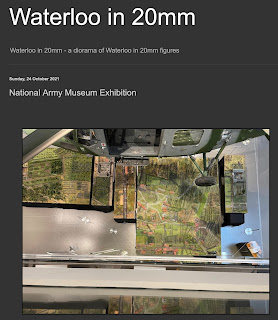
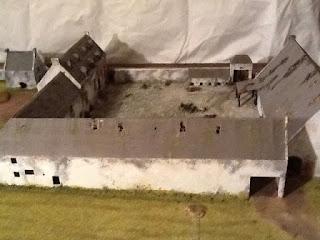
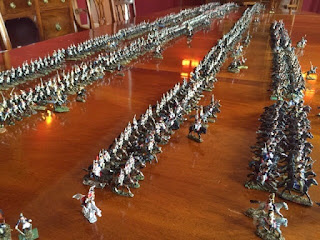
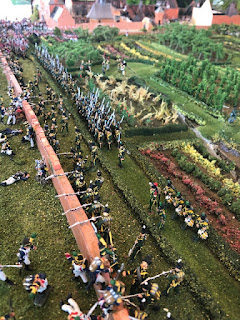
James has updated his blog (generalpicton.blogspot.com) with some photos of the Waterloo diorama at the National Army Museum in London. Check it out if you have not already. It is absolutely superb, outstanding and magnificent.


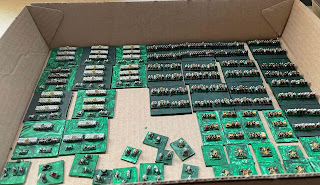
What's even more amazing, there's more to come. You can see the 'gap' where the Anglo-Allied squares and French cavalry are going to go in the bottom-centre and left of the photo above from my screenshot .

Sunday, 24 October 2021

Re-evaluating 'Miniature Wargaming the Movie'; plus progress

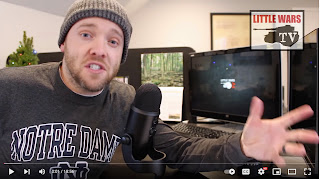
I did not think that I'd be interested in seeing the film Miniature Wargaming—the Movie, but I have gone from 'likely never' to a 'definitely want to see it'. This change came about firstly due to Keith Flint and secondly to LittleWarsTV, Greg Wagman in particular. Thanks Keith and Greg.

A recent post by Keith about the film on his blog led me to look at the review by Greg on LittleWarsTV (from January this year) and then on to the extended interview with Joseph Piddington, the director and producer of the film, in the LittleWarsTV (free) subscriber section.

Greg's frank, detailed and considered review had me interested. He described the quality of the production, the section on the history of wargaming (a recently piqued interest of mine!), which made me think that there would be enough there to interest me. He ended up suggesting to have a look at it, even though he had some reservations about it and felt that it presented a negative image of the hobby as the three/four stories used were not particularly up-beat (to paraphrase). The interview with Joseph, particularly the full-length one, sealed it for me. Here is a genuine and thoughtful person an aspiring young producer-director (no, of course, he is a producer-director) and a passionate wargamer who has produced a thoughtful and interesting film. The target audience is the 'general public' or perhaps, in Joe's words, that friend or relative who wants to know why we do this (seemingly) strange hobby. I reckon that I'll find it interesting too, even if there will be sections that I will not relate to and/or annoy me.

I am sure that the insights from 'industry insiders' about the nature of the business, especially the cottage-industry nature of it, will have much that will be new/news to me. Further to this I look forward to Joseph's next project which will be aimed more at wargaming enthusiasts and which I, as one who generally avoids kickstarter and the like, can see myself chucking in a few dollars to help get off the ground (and paying to view it once it does). I'll keep my eyes out for further news about it.

In the meantime, I'll have to find out how I can see the film. Part of Keith's post was about his annoyance at not being able to view it yet in the UK. Sadly, there was no mention in Greg's interview with Joe about a release in Australia—nor Europe for that matter. Hopefully it will be a matter of time.

Ah time. That limited 'resource' that seems to evaporate when we are doing things hobby.

The two videos mentioned above were really interesting, but were great from another perspective. The videos being chiefly about the words, as opposed to the visual, and those words being in English, meant that I was able to get some basing of my early Austrians done while 'watching' them! Here are a few photos.

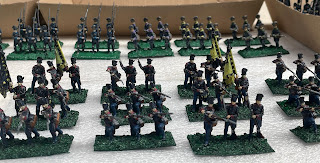
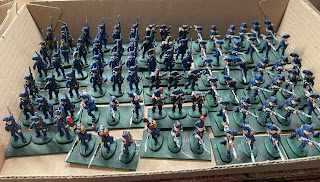
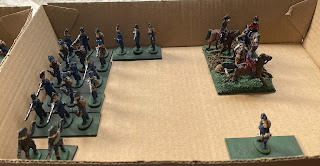
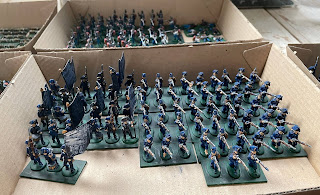
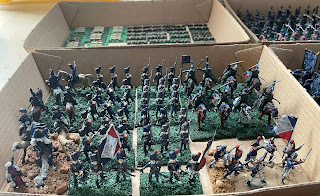
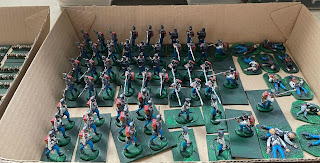
No, not Brunswickers in kasketts, but early Austrians by Italeri. Undercoated some time ago, now most of the fiddly bits done and basing material added. Ready for a few more details and then white.

When I first got a box of these "Austrian Infantry 1798-1805" by Italeri, I thought that they were far to big. They are more like true 25 mm figs than 1/72. I then hit on the idea of basing them on really thin plastic card (the sort that comes as a base in those re-useable, material shopping bags). This is sufficiently thin to make them about the same height as 1/72 figures when the latter are based on my usual 1 mm ABS sheet.
As I have painted them I have liked the figures more and more. The detail is excellent, poses are good to excellent and flags and drummers are plentiful. They are fine
from 1792–1798 and I'll be using them for the Austro-Turkish War of 1788–1791 too. I have also recently found out that many units still wore kasketts in the Marengo campaign, so I'll  be using a lot of them for that too.
All this is just as well since I sought them out from several suppliers when I thought that they were difficult to get and have ended up with twelve boxes so far and another eight to come! Of the fifty figures per box, thirty-five are in kaskett, nine in helmets (including the officers above) and six
grenadiers (seen at the back of the photo above this one).

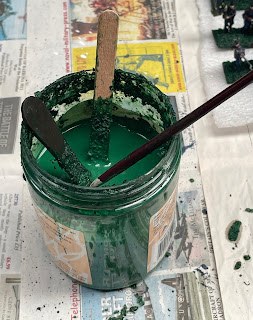
My basing material (green): PVA glue, acrylic paint, sand, old, dried coffee grounds and old tea leaves. Needs to be stirred often as the heavier materials sink to the bottom.
The latter are two materials that come from a beaut idea of Iain Dickie's in his "Wargaming on a Budget".
I like using this mixture as it is easy to mix, reasonably easy to apply and adds weight to the plastic figures without making them too heavy, plus aids binding them to the base.


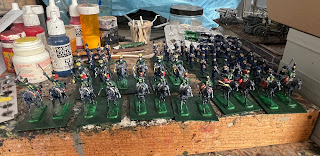
Below are some more photos of my recent hobby 'travail'. It will not look much compared to posts of past progress, but there are some changes: adding 'fiddly bits' like facing colours, and metal for muskets, but also in converting figures to use for Grenz hussars, early uhlans and Polish-Italian legion uhlans.

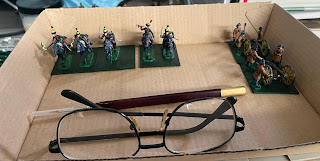
Austrian Grenz hussars with Mézáros uhlans behind. In process of having more 'red bits' done. Also need some colour on the horses, of course!

As above, but with 'red bits' done, plus some artillery—the gunners in greatcoats are the only figures that I have at present. Nothing else is produced in plastic so I intend, later, to supplement these with some from Irregular and Newline.

Polish-Italian legion uhlans. Blue and crimson needed to make these look like something, plus some colour on the horses too.

French infantry, also with some of 'fiddly bits' done. A splash of red added to some of the grenadiers when I have had some 'decanted' paint to use up. Plenty of blue and white, plus some more red needed. Strelets "French Line Infantry in Egypt" with a few head swaps.

More French infantry, plus Napoleon at Marengo as one of my vignt-et-un Napoleons.

More French infantry, Strelets "French Line Infantry in Egypt" again, with some converted to flag-bearers using flags made from tin foil from Milo lids or from around wine bottles. The flags will be shaped once painted.

Consular guard (for 1800), three more of my vignt-et-un Napoleons and Napoleon's guides for 1796 (and I'll use the same figs for Egypt). A mix of many figures and conversions there.

Austrian grenz. I started these some time ago, then put them to the back while other figures (those above and my First World War figures) took precedence. The grenz units in Italy in 1796 (and in 1809) had white coats. I'd like to get all the Austrians to the stage of the white-coated grenz here by the 4th. Figures are Hat grenz and I'll use as is for 1796, despite the backpacks and blanket rolls being worn over each shoulder rather than slung. I considered some 'cutting and trusting' to convert them, but decided against it!

Most of the 2 mm Austrians. I'm doing them as circa 1809 (much as you can tell) and they have had yellow added, hence that colour standing out!


Julian and I are catching up for a session on the 4th. I want to have a go at the Battle of Voltri using a my first pass/adaptation of Kriegsspiel. It has been twice delayed due to 'other things' cropping up. I have been happy about that as it has given me more prep. time. I'd like to have the above figures looking a good deal like they are meant to, so at least have the base-coat done. Some more of the 'fiddly bits', some more basing and then I'll be applying white, white and more white;

Wednesday, 13 October 2021

Waterloo Remodelled—a magnificent diorama at the National Army Museum London

Since early 2014 Major General James Cowan (aka 'General Picton') has been working on a magnificent diorama of the Battle of Waterloo. He began his monumental project as a solo effort, but more recently has been assisted in the task of painting the (now) ~30 000 1/72 miniature figures (metal and plastic from numerous manufacturers) by "contributions from UK, Europe, USA, Canada and Australia". Hats off, a huge cheer and sincere congratulations and thanks to them all!

The sensational diorama Waterloo Remodelled.  Image from 'Deadlines' on Waterloo in 20 mm blog.
 

I have been following James' wonderful Waterloo in 20mm blog about the project for most of the past seven years. He has posted regularly about his research into the buildings, uniforms and battlefield, as well as updates of the work. They have been an absolute joy to view.

A few weeks ago he posted the exciting news that the diorama will be on display at the National Army Museum in London between 20-23 October. If you will be anywhere near London during that time, get along and see it. The rest of us will have to enjoy it from a distance.

Further details about the display are available at the website of the National Army Museum and at Waterloo Uncovered.

I have included but a few photos from his blog below. Do yourself a favour and check it out from inception to near completion.

Well done to all and especially to James on his drive, wonderful painting and modelling.

Early days. Image from 'Introduction' on Waterloo in 20 mm blog.

Hougoumont takes shape. Image from 'Hougoumont' on Waterloo in 20 mm blog.

Above and below, some of the masses of troops. Various 1/72 metal and plastic figures. Images from 'Cuirassiers' on Waterloo in 20 mm blog.


A square of Hanoverian infantry. Image from 'Bremen and Verden battalions' on Waterloo in 20 mm blog.

Above and below, Hougoumont attacked. Images from 'Hougoumont a battle within a battle' on Waterloo in 20 mm blog.

Casualties. Image from 'Reality of war' on Waterloo in 20 mm blog.

Plancenoit. Image from 'I've been working on my Plancenoit' on Waterloo in 20 mm blog.

The Guard advances. Image from 'Deadlines 2' on Waterloo in 20 mm blog.


Sunday, 3 October 2021

And now for something completely different: Lee vs Napoleon

This is a joy to behold. The latest 'active diorama' from Michael at 1/72 Legions In Plastic Depot is an alternative history in which Napoleon invades the United States and confronts Lee and his Army of Northern Virginia. Plenty of suspension of disbelief required but it is superbly done and had me beaming from ear to ear!


Click this link to see the video

I love that he adds the caveat/disclaimer of "Not intended to be 100% historically accurate", just for the pedants!

I became aware of Michael's marvellous dioramas after I ordered some figures from him via his 1/72 Legions In Plastic Depot store. He brings together the playfulness of the toy soldiers of our childhood with the patience and sheer capacity of the model soldiers of our adult selves.

This video is one of his "Bedroom Floor Battlefield series". He uses primarily 1/72 plastic figures with classic 25 mm figures added in. As one person commented on the video, it is fun to play 'spot the figure'.

If you liked this (and I can't see how you could not), then you'll also enjoy his version of Waterloo or the one inspired by Major Dundee. Better still, check out the lot on his YouTube channel.


Some joyous Sunday viewing.

Saturday, 2 October 2021

'Discovering' wargaming history (5) Following in the footsteps of a fellow-traveller: "Le Kriegspiel Napoleon"

"Time to reinvent the wheel", as Joe astutely stated in a comment to my first post in this 'series'. Like lots of wargamers, I have always adapted and even had a go at writing rules. It is little wonder that many, many (many) sets of rules exist for Napoleonic wargaming "dozens, hundreds, perhaps thousands" as 'Marius' ('Figalpage') noted in a recent, excellent post in which he provided a precis of 43 of those published since 2009 (and more besides—check it out. If you are not into trying to practise French, you can use Google translate).

Knowingly or not the authors of each of these sets, produced at a steady rate since the popularising of wargaming in the 1960s and an exponential rate in more recent times, has been influenced by Kriegsspiel. For most, I suspect, this has been via other, earlier sets of rules, but who knows as so few of them bother to acknowledge the sources of their inspiration (it's okay, I'm hopping down from me soap-box now...). Despite my rude comments about near or actual plagiarism, I actually embrace this great variety because, like 'Marius', I reckon that it provides a heap of options for games at a range of scales in terms of figures, table, battle, time and players' preferences. This is not limited to Napoleonics, of course, but the sheer volume of rules for this era and the rate at which they are produced reflects the huge interest in this 'pinacle' of wargaming periods.

What really excites me about my current attempt is going back to the 'source' (noting that formal, 'ruleset zero' is further back still, let alone the ancient versions). Prior to reading Kriegsspiel I was back on the track of wanting to produce a rules system to suit my interests, using elements of various sets that I like. My excitement with Kriegsspiel is in 'finding' an original, contemporary set of rules for Napoleonic warfare that I think will form the basis of this. My interest was piqued further last weekend when I 'found' Le Kriegspiel Napoleon, written by Jean-François Gantillon.

Jean-François is a fellow traveller who has produced his own adaptation of Kriegsspiel, which he calls Le Kriegspiel Napoleon. I say that I 'found' as these rules, in quotes, since they have been under my nose for sometime. Jean-François contacted me via my blog in February this year and I began to follow his. It's all about timing though, isn't it? Since, at that stage, I did not have an appreciation of Kriegsspiel so I did not look into his version. Now, prompted by seeing it as one of the examples on Marius' post, I have rectified that omission.

Le Kriegspiel Napoleon is available as a pdf file from Wargame Vault, either in French or English. I would have liked to have been able to purchase both the French and English versions, but had to choose so went the lazy route of getting the English translation. The rules are well-laid out, interspersed with images of games, troops, historic paintings and such, and include tables, unit characteristics (for troops of France, Britain, Saxony, Poland, Württemberg, Northern Italy, Prussia, Bavaria, Denmark, Sweden, Westphalia, Russia, Austria, Spain, Naples) and numerous playing aids (that are also available on Jean-François' blog), although no quick reference sheet per se. The guts of the rules comprise around 72 pages of the document, spread over some 97 pages by full pages of images and examples. The entire pdf is 200 pages long, quite nicely produced, but clearly an amateur production. At US$33 for a pdf file they are not cheap and I reckon that they should be about half the price—it was only my particular interest in Kriegsspiel and adaptations thereof that lead me to make the purchase, but I am not disappointed that I did.

Screenshot of part of a page of Jean-François' blog, with links to the player aids available to download.

Le Kriegspiel Napoleon
is quite different from the Napoleonic army level Kriegsspiels (available via the UK Kriegsspielers website), which is an
adaptation of Kriegsspiel but still a map-based, strategic game using blocks or counters. Jean-François' set has been written specifically for a 'history game with figurines', scaling Kriegsspiel to turns representing 20 minutes. He has used battalions, two squadrons and batteries as the basic units, so broadly the same as Kriegsspiel and has utilised the adaptability of von Reisswitz's system to suggest a range of ground scales, 1:2 000 up to 1 to 3000 for different sizes of basing with suggested numbers of figures per base for 25/28 mm figures down to 6 mm. This also enables all measurements to be done in terms of unit frontage, a 'modern' concept that I had also seen as immediately possible from von Reisswitz's Kriegsspiel. Movement speed is divided into tactical movement speed and a combat move (marche au combat, MaC—most of the abbreviations/initialisms are from the French), with an optional 'operational' movement speed (see below). Firing and combat are clearly derived from Kriegsspiel, but overall Le Kriegspiel Napoleon is a significant departure from the original, with many added mechanics. 

In fact, it is misleading for me to suggest that Le Kriegspiel Napoleon is an adaptation of Kriegsspiel. While the influences of Kriegsspiel are there (per above), Gantillon has utilised and been influenced by other works on military strategy and theory, wargaming and weapons (provided in his reading list*). Chief amongst these are the writings of Colonel Charles Ardant Du Picq, to whom the rules are effectively dedicated with the subtitle 'Project Ardant Du Picq'.
*It's interesting that Empire is not amongst this list when there are several mechanics that seem Empire-esque to me.

This post is about relating Gantillon's rules to my thoughts on where I'd like to go with a system derived from Kriegsspiel, so is more about the rules in that context than a review per se, but a brief summary is in order and still relevant. The main rules are divided into sections about the game sequence, command, movement, combat and victory conditions, with numerous sub-sections. These are quite easy to find from the table of contents, assisted by separate 'page of pages' numbering for each section (in addition to the page numbers of the document), but there is no index.

The sequence of play

The game sequence is semi-alternate, with each player alternating as the first player in a predetermined sequence of side A odd turns and side B even. This immediate departure from Kriegsspiel is a clever way of dealing with simultaneous movement versus alternate and removing the requirement for an umpire. (Mind you, Richard Zimmermann's system of two half phases to a game turn, with shooting between the two, switching between which side is first in each phase and an initiative die roll to determine which side chooses to go first or second in the first phase is the most clever method that I know of).

Each game turn begins with placement of any reinforcements by both sides and is then divided into seven phases; Orders, Operational Movement (conducted simultaneously), Tactical Activation (for the side going first and then that going second), Combat Resolution, Escape Movement, Removal of Order Cards and Advance the Game Chronometer. After Operational Movement and during Tactical Activation, units of the non-phasing player may react by direction, requirement or even at the request of the phasing player (some automatic, others requiring a test).

Le Kriegspiel Napoleon has two levels of orders. The basic game uses command ranges to determine whether each unit is in command. Units are in command if within command range of their commanding officer or in a 'string' of units (within two base widths) of the same tactical group (roughly a brigade) that are in command. Units that are out of command have limited opportunities for movement and action, but there are options to move a commander (one base width) at the beginning of the phase to bring them into command. If the optional 'Attitude Orders system' is in use, then each tactical group will be issued an order (Defense, Support, Attack, Manoeuvre) in addition to the use of the command ranges. Orders cost command points to issue, with these points determined by the size of the army, number of units demoralised and officers.

Like Empire, Le Kriegspiel Napoleon has two types of movement; operational for moving troops large distances across the battlefield (an optional aspect of the rules) and tactical movement. The essence of the Operational Manoeuvre phase is remarkably similar to Grand Tactical Movement in Empire with order cards being turned over, orders declared and movement made. Rather than being part of only one player's turn, this is done within each turn by the first player and then the second, with a few reactions possible by units of the non-phasing player at the end of each side's manoeuvring. Once units that can move at operational speed (outside Tactical Stopping Distance) have moved, those that could not do so may make a move at tactical speed.

Tactical Activation involves supporting fire by artillery, artillery bombardment, infantry support fire, deployment of skirmishers and march to combat. The player whose turn it is to move first completes tactical activation for units within a tactical group at a time and concludes by conducting reorganisation and rallying. The units of the side of the other player then conduct tactical activation, but these are more limited in scope and range.

Combat Resolution involves the resolution of actions conducted in the Tactical Activation phase. Artillery bombardment is resolved for the side whose turn it is, then the second side. Next, advances to combat are carried out and then resulting combats are resolved and mandatory movement carried out. The turn ends with

Example of a table, the Combat Resolution in this case, showing the adaptation of Kriegsspiel in this aspect. Tables in Le Kriegspiel Napoleon are colourful, produced in a large font, but are busy and take time to comprehend.

The rules are full of abbreviations and initialisms, an aspect of so many sets of wargame rules that I find frustrating. The frustration is slightly less with Le Kriegspiel Napoleon as Jean-François has provided a 'Keyword Index' at the beginning of the rules and a list of acronyms and abbreviations at the end (the latter in French and English).

As with von Reisswitz's Kriegsspiel, Le Kriegspiel Napoleon are detailed and take time to become clear, but are actually easy to follow in their key mechanics. Most of the detail comes in explanation, specific examples and situations. Like Kriegsspiel, the more I looked and read in detail the more I appreciated and was impressed with the concept of the system. I was originally going to conclude this post by saying that I do not expect to use Le Kriegspiel Napoleon at this stage, but in compiling this post I become more and more interested in them, so expect that I will give them a go (at the very least). I certainly do expect that I will consider Jean-François' approach in the course of my own adaptation of Kriegsspiel. In my first outing I will stay closer to von Reisswitz's system, with compounded moves depending on proximity to the enemy, but then all moving to standard moves once necessary. I too can see the need for a orders, but, like with all aspects, I am going to begin with actual orders rather than categories of.

I expect this will be the last post of this series (but, who knows what I'll 'uncover' next?). Time for some of that metaphoric rubber to hit the road.

References 

Gantillon, J-F (n.d.) Le Kriegspiel Napoleon blog. Créé par un Passionné : pour des Passionnés du Jeu d'Histoire avec Figurines.

Gantillon, J-F (2020) Le Kriegspiel Napoleon rules (English version of Le Kriegspiel Napoleon 2018) available as a pdf download from Wargame Vault ($US33).

James, M (n.d.) Napoleonic army level Kriegsspiels. Kriegsspiel a website dedicated to Kriegsspiel run by a "group of UK based Kriegsspielers, who meet a number of times a year at Little Gaddesdon, Hertfordshire, UK".

von Reisswitz, GH, Baron (1824) Kriegsspiel. Translated by B Leeson. Too Fat Lardies, 76 pp. Available to purchase as a pdf from TooFatLardies.

Zimmermann, R (1973) The Wargamer's Handbook: Rules for Wargaming in Six Periods of History. Z & M Pub. Enterprises, 74 pp.

Monday, 20 September 2021

'Discovering' wargaming history (4*) The most enduring Prussian contribution to the art of war

This is how Jorit Wintjes introduces his 2015 paper "Europe’s Earliest Kriegsspiel?", a paper that I 'stumbled' across as a hit from an internet search around 'Kriegsspiel'. It's a most interesting read, so I was extremely pleased that this 'guided' bit of serendipity had sent the paper my way.

Wintjes' tells us about an early war game, "Kartenspiel" created by Reinhard Graf zu Solms, a Hessian who was an artillery officer and military engineer in the Imperial army in the early 16th century. In addition to being a successful soldier, zu Solms was "a man of letters". Wintjes tells us of his main work, "Kriegsbeschreibung", which was "...an encyclopaedic study of military science, aiming at covering all relevant aspects of warfare". It is within this work, that he produced "Kartenspiel".

Two of the images from the paper, showing troops used in the game Kartenspiel.


As the name suggests, the game is based on cards. Wintjes describes the cards used in the game, representing infantry, cavalry and artillery of two sides as well as different strengths and formations, providing some examples of each. The rules of the game are simple and relate to the disposition and formation of the troops. There are no rules specified for combat. Wintjes suggests that, while the game may have been limited to movement and dispositions alone, it is likely that a combat system existed since two sides are represented.
The "Kriegsbeschreibung" has come to us in eight complete volumes and part of a ninth. The rules for combat may well have been published (or intended to have been) in another volume.

In addition to describing the military life of zu Solms and Kartenspiel, Wintjes' paper extremely readable and edifying paper, provides background regarding von Reisswitz's Kriegsspiel, its predecesors (identified by von Reisswitz) and the impact that the game had on Prussian military training and that of other nations. I found this part of his paper as interesting and illuminating as the main topic. His assessment of the enduring importance of Kriegsspiel, that I repeated in the title of this post, is made since "...armies have used war games ever since and are likely to do so for the foreseeable future...".

The paper is available as an 'open publication', for any and all to download and to read. It is worth doing so if you are interested in the history and impact of wargaming, in both hobby and professional capacities.

*I have not forgotten my 'counting skills', the third instalment in this 'series' is on my other blog, for anyone interested.

Reference

Wintjes, J (2015) Europe’s Earliest Kriegsspiel? Book Seven of Reinhard Graf zu Solms’ Kriegsregierung and the ‘Prehistory’ of Professional War Gaming. British Journal for Military History 2, 15-33. https://bjmh.gold.ac.uk/article/view/634


Thursday, 16 September 2021

'Discovering' wargaming history (2) Getting 70–80% of the way there

In my previous post I mentioned my amazement, embarrassment and delight at 'discovering' the 1824 Kriegsspiel rules*. I was particularly taken by how different they are from my previous understanding, which I now realise was based on descriptions of the later 'free' Kriegsspiel. In this follow-up post I will outline some of the key mechanics in the rules and why, in reading and studying these rules more, my initial amazement and interest has changed to considering that they will get me 70–80% of the way there (perhaps even more).
*In looking up links and references for this post and Kriegsspiel in general, I came across a recent paper by Jorit Wintjes about an earlier, non-chess 'wargame' (see References below). I have only skimmed it so far.

A section of a game of Kriegsspiel. From 'Kriegsspiel 1824 The Prussian Army Wargame' translated by Bill Leeson, p. 4.

I do not for a minute expect that anyone will have the same reaction as me in wanting to use the rules, but you may well be interested to learn more about them for pure edification.
As I describe the mechanics of Kriegsspiel I am sure that, like me, you'll recognise many (most, perhaps all) of those that were used in the 'mechanistic' wargames rules of the 70s and 80s. What is more astounding is that Kriegsspiel also contains several of the 'abstract' elements of 'modern' sets of rules.

Like all posts, this is written due to my own interest in the topic, but also in the hope that it may be of interest to fellow-wargamers/bloggers. It's a long post, so I have added sub-headings so that you may skim the bits that you want to read; or perhaps just look at the pictures!

Background and materials

Kriegsspiel, as written are small-scale and detailed rules. The rules are intended to be played using a series of maps. It is suggested that four to six sections be combined for any particular game map. The maps indicate slope (graphically as they pre-dated contour lines), towns, villages, roads, woods and other terrain features. The ground scale was 1:8000 (although Bill Leeson adapted this to 1:7500 in the translated version available from TooFatLardies). Troops are represented by blocks, coloured red and blue for the two sides with symbols and numbers to indicate whether infantry (line or skirmishers), cavalry or artillery; the type and/or calibre of each. These were made of lead in the shape of small blocks in the original Kriegsspiel 'apparatus'. (There is a wonderful article on the Kriegsspiel website—address of site in reference list below—which includes photographs of the original 'apparatus' from a museum in Berlin). The minimum infantry block is a half-battalion (two companies wide, occupying 125 paces), squadron for cavalry and half battery for artillery. I'll explain more about these later and how formations are represented, under movement.

The troops in Kriegsspiel represent standard strength formations. "A battalion is 900 muskets with a frontage of 250 paces, including battalion intervals. A squadron of 150 riders has a frontage of 100 paces. A battery of 8 guns has a frontage of 200 paces when the guns are placed 24 paces apart^" (p. 7). Here we see the first example of how these rules were 'ahead of their time', consider how the standardised unit that has become a trendy thing in 'modern' rules!
^A compressed frontage was also permitted, see Movement below

Each move in Kriegsspiel represents two minutes. All movement and ranges are measured in paces and rulers were included in the 'apparatus' with the Kriegsspiel rules to use for measurement (von Reisswitz states that a set of calipers could be used as an alternative).

Game sequence

There is no game sequence, per se. It's funny. I have been so engrossed with the detail of the rules and how they relate to later 'offerings' that I did not think about this until I was considering what I wanted to put in this post.

Kriegsspiel are designed to have the scenario constructed by the umpire who carries out the movements (and rolls the die) according to the orders of the players. Movement is therefore simultaneous and firing and other attacks occur according to orders and circumstances. Therefore, there is no need for a command phase, move phase, fire phase, or such as the orders from the players, messages to and fro, time taken for events to occur and 'all seeing ominpresence of the umpire' (my words) make it clear what occurs when.

This is described by von Reisswitz in his introduction as follows.

Time is divided into two minute sections which are known as “moves”. The rules on movement, conflict and so on, are based on these two minute moves, and a player will see the result of two minutes action for each move that passes.

The player can move as many troops as he wishes during the move, and they can, of course, be moved in any direction. The troops will only be allowed to move as far in one move as they would be able to march in two minutes of reality. ...

During this time, of course, the enemy will also be moving his troops, or if he is already in the desired position he may be calling on them to open fire.

The result of firing for two minutes must, similarly, only be what one could reasonably expect, based upon experience, in that time. If an advancing column is to be deployed for an attack each battalion has to be brought up to position, so that the head of the column will have to be halted long enough for the tail to arrive. If this takes two moves to do then it means that the column took four minutes to deploy.

Dividing time into two minute intervals allows us to make sure that no more or no less, will happen in the game than would take place in reality in a given time.
I'll come back to this later in my considerations of how I might use the Kriegsspiel system.

Movement

There are movement rates for infantry, cavalry, artillery, patrols, messengers and wagons. Varying rates are given for marching as opposed to attacks, pursuits and retreats. Movement is modified by terrain. There is no adjustment for formation.

What?

I thought about this and realised; this is yet another one of these aspects of wargaming lore. Oh, lines move more slowly as it was more difficult to maintain order. Poppycock. Troops had a march rate. You can have a slow march for ceremonial purposes, ordinary march rate and quick-time; perhaps even 'running away' speed. Formation is a factor of purpose and terrain. This is how it is done in Kriegsspiel. Troops do not march across vast tracts of land in line in the 'modern' army of the early 19th century. Witness the quote from von Reisswitz above. This did not need to be spelled out to the officers in the Prussian army of the day. It is such aspects of the rules that add to my sense of excitement about them as a system for historically-based wargames of the Napoleonic period.

The movement table in Kriegsspiel. From 'Kriegsspiel 1824 The Prussian Army Wargame' translated by Bill Leeson, p. 28.

Formations are represented in Kriegsspiel by adjusting the facing and stacking of the troop blocks. Infantry in line are represented by two half-battalions side by side. A column of division by two blocks one behind the other. A column of companies by turning the blocks side on and stacking one on top of the other (one behind the other for an open column when marching/manoeuvring). A closed column is represented by the blocks stacked one on the other with two-company facing (up to four in the stack). Squares are not specified in the examples in the rules (but are noted as the formation for receiving cavalry), so presumably represented in the same manner. Skirmishers are denoted by smaller blocks. "A battalion can use four skirmish blocks without affecting its frontage. If a player wants to use more men in the skirmish line – for the defence of a village or wood for example – the frontage will be affected and the exchange pieces should be used" (p. 13).

Cavalry squadron blocks (which are square) may be deployed in line, column of route, open column, closed column, two divisions or squadron columns. There are separate blocks for cavalry skirmishers.

Some formations of cavalry. From 'Kriegsspiel 1824 The Prussian Army Wargame' translated by Bill Leeson, p. 19.

Artillery are deployed on normal or compressed frontage. For movement, they are arranged one behind the other, possibly stacked to denote open or closed columns. They may also move as whole batteries in line abreast.

Firing

The infantry fire table is divided into fire by a half battalion or skirmish 'zugs' (roughly equivalent to a platoons). Skirmishers are further divided according to whether in cover or not, the latter being separated for line infantry skirmishers and jägers. Casualties, in points, are determined by the type of troops, range and roll of a six-sided die. Points translate to casualties according to whether infantry in two ranks, three ranks, skirmishers, cavalry or artillery. This is another brilliant mechanic in my book. The effect of fire does not vary according to the target, but the impact does. In the end it is bit of a matter of semantics as whether you have a separate table for different targets or adjust the fire points, but I consider von Reisswitz's system to be so much more elegant.

The use of different fire tables for skirmishers in cover or not is explained as "...we give an advantage to marksmen in the skirmish line who are under cover, and who are consequently able to take aim with more care and less agitation" (p. 32). This is an example of the detail in these rules, but it's a nice addition, I reckon (at least in theory#).
#More on this under The 1828 Supplement below

The artillery fire table is divided into four calibres (to encompass the Prussian guns of the time) with four range categories each. The die results (all dice used in the rules a six-sided, the only dice at the time) are separated into good effect and bad effect, with different hit points each. Good effect is when the ground between the battery and the target is even, with no slope up or down more than 10° (for canister shot, low elevation shot and random (long range) shot). It also applies at high elevation range when the battery has a clear view for 200 paces before or behind the target. Bad effect is when the ground between the battery and the target is swampy, marshy, full of hedges, broken or undulating, or has a slope up or down of more then 10° (for canister shot, low elevation shot and random shot. Also for high elevation shot when the ground between the battery and the target is swampy or marshy, or when the terrain between the battery and the target rises or falls more than 20° or when there is not a clear view of the target.

The impact of cover (for the target), formation, ranks, flank fire are covered separately. There is a morale effect of artillery since "it cannot be assumed that the troops will remain still for long under effective canister fire or low elevation range fire without either going forwards or back" (p. 34). A die is rolled (Die 2, see Assaults below) and, if in the favour of the artillery "...the troops must retire without any other penalty apart from the losses from artillery fire. If the dice falls in favour of the target they can choose to stay where they are or to advance, whereupon Die 2 will be used again in the next turn with the same implications" (p. 34).

Artillery fire against structures is covered separately, with chances of setting them on fire.

Assaults

"The relative formations and arms of the opposing forces, numerical strengths involved [and] the circumstances of the attack, in terms of troop quality, terrain and external influences" (p. 38) are all considered when troops are attempting to "attack at close quarters". One of five possible combat dice, representing different odds, are used depending on the circumstances. The particular die is set by the situation of the close quarters combat (formation and arms in combat), with shifts in the die to be used and/or of the results for numerical strength, support, flank/rear, supporting troops.

An example of how to read one of the dice (above). Fortunately, Bill Leeson transposed the five to a tabular form for ease of reading and use (below).


The outcome of an assaults falls into one of three categories. Troops can be 'repulsed' whereby they "...have turned back from the attack, but they remain in good order as they retire, without significant losses"
(p. 44) or be 'defeated' (turned back), involving greater losses and three turns before they can defend or six before they can assume the offensive. The worst outcome is 'totally defeated' whereby the troops go back in 'full flight', take more losses and require
five turns before they can rally for defense or ten before they can assume the offensive.

Both sides take casualties in assaults. The losses of the loser are indicated in the close combat table. Attacks that succeed take losses from fire in the turns leading up to the assault. Defenders that beat off an attack "...suffer 10 points for each half battalion block, and five points for each skirmish block" (p. 44). The retreat of defeated troops and pursuit by the victors depend on the type of troops and level of the victory/defeat.

Other rules

The above summarises the main mechanisms in the rules. In addition to these are the rules for attacking strongholds, surprise attacks, prisoners, attacks by night and bridges & fords.


The 1828 Supplement

The 1828 supplement to the 1824 rules is provided along with von Reisswitz's original in the pdf from TooFatLardies. This supplement was the first of many follow-up or derivative versions of Kriegsspiel—a bibliography by Bill Leeson provides a convenient list of these in one place

The foreword to the supplement (15th March 1828) states that:

It has been felt that the rules, as they exist, leave a number of gaps in the treatment of attacks, and a number of officers from the Berlin garrison have got together with the purpose of amplifying them in certain instances.
The group formed a committee representing the three arms of the service – infantry, cavalry, artillery – with each arm represented by three officers with campaign experience, who were familiar with the game. The committee spent almost the whole winter of 1826 in the creation of new rules which would provide more guidance in the treatment of battle situations, and would at the same time modify the unnaturally heavy losses given for artillery fire.
The new rules were tried out many times in the following winter, and as they proved to be workable the committee decided to get them printed so that they might fill a much-felt need among Kriegsspiel players.

One need hardly add that the rules were not put together in haste, but are the result of many discussions. Sometimes a single rule would take up a whole sitting of the committee.

The discussions took the existing rules as a basis, and in fact the existing rules remain largely unaltered. Where there are changes the new rules are given under the same section headings as in the existing rules to make comparison easier. We have also added a new set of dice that the reader will be easily able to make use of.

At first I worried that this 'second edition' of the rules would suffer from the same problem as do so many follow-up editions to rules today; they include extra detail, people's pet peeves and hence a loss of much of what was good in the original. Fortunately, I was mistaken.

Rather than adding, the committee removed some of the detail (impact of cover on the fire of skirmishers, for example), reduced the casualties of firing~ (as described in the foreword), included the effects of cover, clarified specifics (such as artillery shot to good effect and bad effect) and added more detail and clarification around assaults (which previously relied a lot on the umpire's interpretation as to shifts for conditions, troop quality and the like).
~Interestingly, Rob had made a comment about this in response to my previous post.

Bill Leeson's tabular presentation of the adjusted fire table (above) and assault/close combat table (below) from the 1818 supplement.


All in all I get the impression that the rules have been improved because the committee built on and added clarity to von Reisswitz's system. This seems to have been one committee that did not make a camel!


How I might use Kriegsspiel

When I first read Kriegsspiel, I was amazed at the content (realising now that I had expected 'free' Kriegsspiel). I was really impressed by aspects such as the use of paces making the rules scaleable, use of hit points, the combat system and sensible approach to morale effects. When I was relating my latent 'discovery' to Julian (who also thought that they were a descriptive wargaming system) he said, "Why don't we give them a go?" "I don't think that we'd want to use them," I answered. I considered them to be too detailed, cumbersome and I certainly did not want to go back to two minute moves!

Or did I?

As I read and studied the rules more and more and related them to the ideas that are bubbling around in my head I came to the realisation that here, perhaps is the foundation (at least) of what I'd like in a set of rules. I have been seriously considering going back to produce a set of rules for myself, taking into account various mechanics and approaches that I like in others to produce a system that I think will provide the semi-game simulation I am seeking. I realise that I am gonna tread a well-worn path and there will be plenty of reinventing of wheels (and other devices), but the study and learning involved is all part of the fun for me. Besides, I do not expect to impose them on anyone else. Still, I am pragmatic enough not to do it all from scratch.

I will start with Kriegsspiel, have a go with it 'as is', either 1824 first and then 1828 or more likely putting the two together in the one 'game'. Well, sort of 'as is'. I will bring in elements that I have in mind from other rules to add aspects that I want to include. The rules March Attack, which are effectively what I term an 'Empire-successor' set of rules have a beaut system for translating unit strengths into strength points. I long ago decided to use this to produce different sized units on the table top, whereby a strength point (combat value in March Attack parlance) would be represented by a base of figures. I'll use this to have various sized units.

I intend the two minute moves to stay, but expect to be able to scale them up when the armies are chiefly manoeuvring and go to detailed, step-by-step moves when the action is 'hot'. Sound familiar to anyone?!

There will be quite a lot of record keeping. As a concept this does not phase me. I am looking for description and detail and am happy to take my time. That said, I will need to devise a simple and easy-to-use table/grid for noting what needs to be noted and set of markers to use on the table where appropriate and visually pleasing.

Having been conceived around 1811 and published in 1824, Kriegsspiel are of the late Napoleonic period. Skirmish tactics are standard. Corps structure exists (even the British had come to it by then), concentration of artillery, cavalry organised to be l'arm blanche. This is all explicit or implicit in Kriegsspiel. Depending on the game, I will may to overturn some of this. I'll use aspects of Empire, Chef de Bataiilon and Napoeon's Rules of War, as well as Nafziger's Imperial Bayonets to assist me with this. Along with these the accounts to the particular action that I am wanting to play out will/may provide guidance.

Then there is command and control. As mentioned above, this is at the heart of Krieggspiel, so is intended to be represented by players. I'll use some combination of categories from Empire, indicated by an arrow per Shako. The flexibility of what troops can do if their existing order is challenged by circumstances will be determined by specific limitations (per Empire) and perhaps with different initiative ratings for commanders; or interpretation by the umpire. I can see that there will be an element of 'free' Kriegsspiel.

A recent post by Jennifer on her excellent 'Librarian Gamer' blog explaining free Kriegsspiel with a clear and simple example has inspired me to possibly included aspects of that approach for some interpretations or situations outside the letter of the rules or aspects that would so often be decided by a roll of the dice (which I want to avoid). This was a key part of von Reisswitz's Kriegsspiel, so not anything new or particularly different anyway; depending on how far I take it.

The Battle of Voltri seems a great place to start. This will be in keeping with my intention to make this year the start of my quasquibicentennial / vigbicentennial Napoleonic anniversaries (with the 225th anniversary of 1796). Voltri is an action involving relatively small and geographically spread forces, so could be ideal as a testing ground, not only for Kriegsspiel, but for my 'telescoping scales concept'.

My table, a bit like my head, is cluttered, but there is some order in the chaos and also some space to try out a game of some kind. The Battle of Voltri 10 April 1796, using whatever troops I have to hand sounds good...

I subtitled this post 'getting 70–80% of the way there'. It remains to be seen whether my impressions of Kriegsspiel will survive 'contact with the enemy'. As Keith put it in a comment to my previous post, it will be interesting "to see how you translate this burst of inspiration into practical use on the tabletop!".


References

Kriegsspiel, a website dedicated to Kriegsspiel run by a "group of UK based Kriegsspielers, who meet a number of times a year at Little Gaddesdon, Hertfordshire, UK" Link to home page.

B. von Reisswitz B (1824) Kriegsspiel. Available to purchase as ''Kriegsspiel 1824' as a pdf from TooFatLardies.

Wintjes, J (2015) Europe’s Earliest Kriegsspiel? Book Seven of Reinhard Graf zu Solms’ Kriegsregierung and the ‘Prehistory’ of Professional War Gaming. British Journal for Military History 2, 15-33.