Friday, 12 April 2019

Book review: The Napoleonic Wars by JJ Jenkins (and William Heath)

“Originally published as Martial Achievements of Great Britain and Her Allies From 1799 to 1815, … . The text is pure British propaganda but is overshadowed by the rarity of the artwork.” So reads the publisher’s abstract. ‘ A selection from the book’s ‘prologue, describing a vignette, serves to illustrate;


Represents a rendezvous of those Powers who were engaged in the grand struggle for the independence of nations. A British soldier, in pointing to the Military Achievements of Great Britain and her Allies, alludes to the active part this country has taken in the deliverance of Europe.At the feet of the British soldier reposes a French Warrior, tired of the repeated and decisive defeats he has at length met with under an illegitimate master. The broken Flag-Staff and the Imperial Eagle inform us, that the power of the once invincible Buonaparte is no more. …


The vignette described above.

While there is no doubting Jenkins’ aim of producing a  tribute to Britain’s ‘glorious martial forces’, the book is far more than the pure propaganda piece that it appears to be at first glance.

It contains 53 images, including the vignette, plus a representation of the coat of arms of the 33rd Foot (Wellington’s regiment) inside the front cover (the 1815 publication was dedicated to the Duke). This Pen & Sword reprint is subtitled “As illustrated by J. J. Jenkins”, but the artwork was, in fact, painted by William Heath (1794–1840), as referenced here, here and here to accompany Jenkins’ text.

Heath’s plates are stunningly reproduced in colour, with each printed on a single page, and they reward careful examination. One would not rely on them for historical accuracy, details of terrain and certainly not for uniform details, but they present, in a stylised form, key events and terrain features in each of the battles. Many also include details in the foreground, such as wounded, dead or dying soldiers, skirmishers, officers or Spanish irregulars.

I had only seen two or three of the paintings prior to reviewing this book. A feature that stood out to me, and one that is common to nearly all of them, is the representation of the chaos, violence, destruction and death associated with battle. Most troops in the majority of the plates are represented in formation, with only the key details of their uniforms presented. This was edifying from a wargaming perspective, where, despite trying (or succeeding) to paint small uniform details, it is the overall effect that is most important to achieve.


The death of Sir John Moore at Coruña; one of the few paintings that I had seen prior to reviewing this book.

Following the opening vignette is a beautiful drawing of Wellington. Unlike most representations which show him in simple, field dress, Heath has him in full dress with full honours. It makes for a powerful image, which was no doubt as Jenkins intended to have represented “Marquis Douro, Viscount Wellington of Talavera and of Wellington, and Baron Douro of Wellesley; …” (his full description runs to 14 lines!).


The Battle of Talavera. Note the Spanish irregulars in the foreground. The Spanish regulars are mentioned in the text, but not shown in the painting.

The flight of Napoleon after Krasnoi—a fanciful representation.

The vast majority of the plates relate to battles involving British troops. Three of them illustrate disasters from the Russian campaign and another three scenes from the Battle of Leipsic [Leipzig]. The book concludes with a section entitled “The Battles of Quatre Bras and Waterloo, 16 and 18 June 1815” which features a painting of Quatre Bras and two of Waterloo (Ligny is described in some detail in the text).

The meeting of the Allied monarchs after Leipzig. An example of some of the fine detail in the paintings.

The Battle of Waterloo. This painting is an example of the representation of the chaos, violence, destruction and death associated with battle.


While the artwork is a visual feature of the book, the text makes for interesting reading with details and snippets relating to each battle; along with statements like “…most brilliant examples of cool intrepidity…”, “…the operations were successful and splendid” and “…fresh proofs of the superior prowess of British troops”!

A page or more of text accompanies each painting. Jenkins provides a description of the aspects of the battle represented in the illustration, overview of events during the battle or associated campaign (highlighting the British military achievements) and reproduction of the British general’s dispatch, a speech in parliament or other correspondence relating to the battle. At the end of each description is a list of officers killed or wounded in the battle.

The book itself has been beautifully presented by Pen & Sword. It is printed on heavy, gloss stock so that the paintings are clear, bright and colourful. The text is clear with a moderately-large typeface used throughout and clear distinction between Jenkins’ prose and his reproduction of dispatches and other correspondence.


This is a beautiful book to grace your coffee table, or to add to the bookshelves of your collection. While the text may cause you to puff out your chest in jingoistic British pride, to go slightly red-faced, to simply shake your head, or even feel a little queasy, there is much to recommend.


Thursday, 4 April 2019

Book review: The Anatomy of Glory, (still) a favourite

In a previous review, posted on our group's blog, I rated the Napoleonic Army Handbook as a valuable and valued resource because of its combination of detail and general content. No glitz, just full of useful information (albeit with a few minor errors). The Anatomy of Glory is at the other end of the spectrum. This is a gorgeous and valued book due to the subject material, the delightful presentation and the brilliant story-telling of its author—making it a truly treasured tome of mine.

As a boy, I received a copy of the 1978, third edition of this book, published by Arms and Armour Press. It immediately became the favourite in my small, personal collection and remains with the books that Dad kept chez-il. Finding out that Frontline (Pen & Sword) had published a fifth edition (2017) I jumped at the opportunity to receive a copy to review.


I was delighted to be ’reunited’ with the same, wonderful book that I remembered; although with one exception. This version has only 20 colour plates compared with the "over 180 illustrations, including 86 in full colour” of the earlier edition. I am sure that this is a way to reduce the price of the book, but it is a great shame and the only reason that I have given one of my all-time favourite Napoleonic books a mere 9 1/2 / 10!


 One of the black and white plates that was in colour in the third edition.

A glorious painting reproduced in full colour; one of twenty.

The Anatomy of Glory is a fabulous history of Napoleon's Guard: it's men, leaders, campaigns and uniforms. Illustrated with numerous colour and black and white plates (mentioned above), it is replete with fascinating details and comments all told in a witty, conversational fashion. As Anne SK Brown says in her introduction, “Commandant Lachouque has told the story, built around quotations from the letters and reports of the participants, in pithy soldier’s speech. This I have tried to render into colloquial English.” She did a fine job.

The book traces the life, and death, of the guard. The titles of the book’s sections show how the famous formation was linked directly to the fortunes of it’s founder and master: The Guard is Born, The Guard Keeps Watch, The Guard Suffers, The Guard in Splendour, The Guard in Action, The Guard Takes Charge, The Guard At Bay, The Guard Staggers, The Guard Falls, The Guard Dies.

The formation of every unit of the guard is described. Here you will find fascinating details including foundation dates, cost of uniforms and pay; plus interesting observations and insights. Some examples will serve to illustrate.
The Mameluks,
..must cost no more that a chasseur; therefore, since his oriental kit was elaborate and expensive, his pay had to be reduced.” Later though, “the squadron was costly but magnificient—so much so that Bonaparte had to give the Mameluks a bonus over and above their allotment to pay for their kit (pp. 30–31).
The Marines,
Bonaparte, as was his habit, relied principally upon Bonaparte… While he doubted whether soldiers could be made into sailors, he believed he could make sailors into soldiers—provided they were never referred to as such! (p. 33).
Empress Dragoons
Twelve troopers and several officers were levied from each dragoon regiment of the Line to form the first two squadrons, and a third was composed of vélites. The rest of the cadres came from the cavalry of the Guard (p. 71).
Vélites
Napoleon kept this [losses in battle] in mind when planning the Guard’s organisation for 1806. ‘In case of war two companies of vélites will march with each battalion of the Guard … while 420 old chasseurs and grenadiers would be left at the depot in Paris (p. 74).
Polish chevau-légers


On the 30th, before leaving Warsaw for Willenberg, preceded by the Guard, the Emperor directed Berthier ‘to raise a corps of Polish light-horse to be composed of mend with sufficient education to guarantee their morality (p. 86).

Indeed, the reputation and morality of the Guard was of great importance. “The Guard’s renown required that its discipline be severe. A grenadier caught sleeping out of barracks got fifteen day’s arrest and thirty more ‘on bounds’. A second offence was punished by imprisonment. For misconduct a Guardsman was ‘drummed out’ and expelled from the Corps” (p. 74). Naturally, they had to be impeccable on parade. Prior to the Austrian surrender at Ulm “They had to groom their bearskin bonnets, to brush and brush the fur and hang them up by their chin straps so that when they wore them again they could be trimmed and puffed out in the proper Guard style. Forming single file, each man dressed the hair of the man in front, tied his queue just two inches from the end, stuck the eagle pin into the knot, and spread the powder with a brush” (p. 56). On the battlefield was no exception. Such as at Eylau,
By the light of the fires, with soap melted in the embers, the barbers shaved their comrades. Whatever the circumstances, a grenadier of the Guard must present himself shaved on the battlefield (p. 86).
Also at Friedland,
Behind were the big bearskins of the horse grenadiers and élite gendarmes. Noon. The foot Guard arrived, marching to battle in parade dress with plumes and gloves (p. 99).
They were not impressed at being left as observers,


‘A good day’, the Emperor remarked to the grenadiers.

‘For you perhaps… The bulletin will say we have put on full dress to stand with folded arms.’ grumbled an old-timer (p. 99).

It is well-known that Napoleon took personal interest in everything to do with the guard. There are numerous examples detailed in the book. Here is but one,
The Emperor rewarded individual merit with promotion, the Legion of Honour, or gifts of money. Sometimes he even paid men’s debts. … Nothing was too good for the Guard. Cloth for their overcoats cost 29 francs a metre. (p. 72)

Despite this, the Guard’s uniforms were not always up to scratch. As early as 1805, “even the Guard was wearing pantaloons of every colour of the rainbow—Austrian, Russian, and whatnot” (p. 58). By 1808, “the uniform problems was becoming serious. ‘The colour blue is the best… Besides, it is known as our colour throughout Europe’, the Emperor wrote Dejean on 11 July. But because of the blockade, there was no more indigo. Now that the grenadiers’ coats were dyed ‘with plants grown in the Empire’ (principally woad), their colour was quite unpredictable” (p. 130). By 1815 “…rifle [musket] straps were replaced by string… uniforms resembled those of the provincial national guard… not twenty men could be found wearing the same uniform in any company of the 3rd or 4th Chasseurs” (p. 469). These illustrate the myth of the idea of ‘uniforms’ amongst soldiers of the period, even in the Guard.

In Spain, the Guard Marines “…arrived destitute, lacking shoes, uniforms, equipment, and funds. A dispute between the Ministries of War and Marine left them suspended in mid-air” (p. 112). Of course, it was worse for the conscripts in the line, “…neither uniformed nor paid, whose equipment was stamped: ‘Rejected by the Grande Armée’” (p. 116).

It seems that the best ‘public servant’ mentality was alive and well in the early 19th C. Lachouque provides several other examples.
On 7 March [1807], 45 caissons of furnishings for the Guard left the École Militaire. Everything was packed, tied, and tagged, with detailed invoices in duplicate and papers carrying enough signatures and stamps to make the most punctilious commissary swoon from joy (p. 94).
In 1806, Arrighi complained that his dragoons (the Empress Dragoons) did not have overcoats. He wrote to Archchancellor Cambacérès who supported his request in a letter to Dejean (minister of war for administration). Dejean’s response is pure ‘gold’.
… I hasten to reply to the letter Your Highness did me the honour to write me concerning the request of M. the Colonel Arrighi, colonel of the Dragoons of the Guard, for overcoats for 200 dragoons who left yesterday on foot for the Grande Armée. Were the dragoons going to campaign on foot, doubtless I should have granted them the overcoats indispensable to such service. I should equip any cavalry in a similar situation; however, their situation is quite different. On a journey… conditions are not the same as on campaign where bivouacs and night marches make it mandatory to equip foot soldiers with overcoats. On the contrary, this garment, though useful, has never been considered indispensable on a journey, however long… (p. 83).

So much for asides.

The campaigns, marches and battles, naturally, form a major part of the book. They are told largely from the viewpoint of the Guard and its leaders, so there is more detail as the Guard becomes utilised more in combat—Moscow, 1812 is the half-way mark of the book. Lachouque’s style, using numerous quotes from memoirs, draws the reader into the action. A few extracts will serve to illustrate.

Krasnoi
‘Sire’, Mortier replied, ‘I shall hold the enemy back throughout the day. … By placing his troops in two lines instead of three he was able to extend his front by a third. ‘And very thin it is’, a Grumbler observed, ‘like a bone thrown the Muscovites to chew on…’ …The Duke of Treviso, on horseback in the thick of the fire, would hold out until night. … Meanwhile, on the left, the Old Guard had been fighting gloriously to save the fusiliers and clear a path for Davout who was driving a Cossack horde before him. Krasny was on fire, revealing Dante’s inferno. The Russian troopers, yelling like banshees, were sabering everyone they met. The battalion of the 3rd Grenadiers made several charges in the crowded streets, being the last to retire behind the Young Guard and Roguet’s division. … The Old Guard had covered itself with glory. The Russian infantry had never dared attack it (pp. 257–259).

Berezina
While leading his 5th Tirailleurs, Colonel Hennequin’s horse was suddenly decapitated. Officers and soldiers rushed to his aid as he went down in the snow with the bloody carcass; but he was already on his feet. ‘I am at my post, monsieurs’, he said. ‘Let others remain at theirs.’ Hennequin, of whom it was said that he ‘would laugh only if he were burning’, was very rude, but also rather pathetic. As his servant was saddling another horse a piece of bread fell out of one of his holsters. ‘If one of you needs this more than I’, he said to his soldiers, ‘you are welcome to it’ (p. 263).

Lützen
‘The young troops were throwing away their arms which strewed the ground over which we galloped’, wrote Major Chlapowksi of the lancers. … Napoleon’s arrival had an electric effect, filling both veterans and recruits with enthusiasm and reassuring their commanders. … General Lanusse and Dumoustier’s first brigade took Kaya with a charge, overwhelming the Russian and Prussian guards defending the village (p. 293).
The over 180 images on 173 plates are grouped close to the sections to which they are most relevant.

Leipzig
At 9 pm the firing ceased. In their bivouacs behind Liebertwolkwitz the soldiers of the Young Guard saw the Emperor arrive on horseback, preceded by two chasseurs with torches. He ordered Mortier’s divisions to keep fires going to deceive the enemy and march by stealth to Leipzig, relieving Bertrand’s corps at Lindenau and the Elster bridges. …a retreat was now inevitable. … On the morning of the 18th the sentries on the front line peered into a cold mist. They kindled fires with the muskets of the dead while waiting for the enemy attack. … Schwarzenberg was making a determined attempt to cross the river at Connewitz to cut off the French line of retreat. He did not succeed; nor did Wittgenstein at Probstheida, a centre of resistance where Curial’s division covered itself with glory. Nor did Blücher at Reudntiz, though reinforced by Benningsen and the renegade Bernadotte, whose arrival provoked the French army to fury, and in spite of the Saxons and Württemberg cavalry who suddenly turned against their comrades-in-arms. … The shock of forces let loose was tremendous. The ensuing struggle was fought to the death, desperately and without mercy, amid the deadening din of artillery, falling masonry, cries of rage against the traitor whose marshal’s baton was bought with French blood, and shouts of ‘Vive l’Empereur!’ pp. 317–318.
The changing make-up of the grande armée is an interesting bit of detail that Lachouque includes as part of his description of the various campaigns. In 1805, “The Grande Armée now included 180 000 Frenchman, 22 000 Bavarians, 3 000 Württembergers and 2 500 Badeners” (p. 57). By 1806 “On 7 October the Grand Army of 190 000 French and 33 000 Bavarians and Germans were gathered in the Rhine valley…” (p. 78). “In 1812 the Grand Army of Europe consisted of eleven infantry and four cavalry corps totalling 350 000 men with 1 300 guns. These included 270 000 French in 15 divisions, 40 000 garrison troops, and 15 000 foreign mercenaries serving in Swiss, Illyrian and Croatian regiments and the Portuguese Legion. All these wore the French cockade. The 170 000 troops of the European Confederation were divided between Polish, Bavarian, Saxon and Westphalian army corps; Italian, Neapolitan, Württemberg, and Danish divisions; and brigades from Baden, Berg, Hesse, and Mecklenberg. Finally an Austrian corps and several Prussian divisions contained 60 000 allies” (p. 217). A chapter is devoted to the rebuilding of the army in 1813, focussing on the guard as it became an army in its own right.

While clearly admiring and glorifying the Guard, Lachouque is not completely blinded. For example, the irony is clearly intended in his repeating of Napoleon’s comment to Mack at the surrender of Ulm, ‘All empires come to an end’, Napoleon told the vanquished general (p. 56). Then, by the end of 1807,
Drunk with glory, the Guard went into winter quarters. It was the keystone of the arch supporting the Imperial edifice; the order founded by the living god who held dominion over the world and who had assigned it, as a rule, the cult of honour. Napoleon had founded this lay religion on French pride, and raised it to sublime height of virtue and sacrifice. It imbued the soldiers of the Guard with the self-confidence, self-respect, and fidelity that the old aristocracy had acquired by education and tradition” (pp. 106–107). In late 1812, “He had some illusions on the subject, for he did not realise that the peoples of Europe—who only understood later what he had done for them—were about to rise against him p. 275).

I have said much about Lachouque’s colourful prose. Perhaps his best is left for his description of the relationship of Napoleon and the Guard. “The Emperor alone commanded the Guard. No one had the right, nor the power, to touch this prerogative. Whoever belonged to the Guard was under his authority and protection. His gratitude to those who gave him loyalty and devotion conferred grandeur upon the word ‘service’ which the vain and the mediocre consider demeaning” (p 124). Finally, “Napoleon, a citizen of France, was a universal genius. From the Frenchman of his day he fashioned the Imperial Guard and led it to immortality” (p. 505). What an ending to a book.

I cannot recommend this highly enough.

Saturday, 23 March 2019

Towards TSC (2): Basic Training completed

I recently completed the 'basic training' scenario for Chef de Bataillon and they showed great promise. It was an interesting game, the mechanics flowed well and easily—once I had ironed out the last of my erroneous interpretations—and there was a bit of excitement driven by unpredictability.

I began the game again from the beginning as I had made several mistakes in my first attempt. I used the same simple scenario with a battalion of French infanterie légère attacking a British line battalion on a low ridge.


The French approach.


The British wait.


A 'formation' (battalion or lower for infantry) needs to activate on each turn, with the chance (generally and greatly) increasing in subsequent turns for the same order. At first this sounds like a huge pain in the proverbial, but it actually works really well, to manage time and to build tension, particularly when it comes to firing, as we'll see later.


With the chance of activation of around only 20% it was failure for both sides on the first turn.


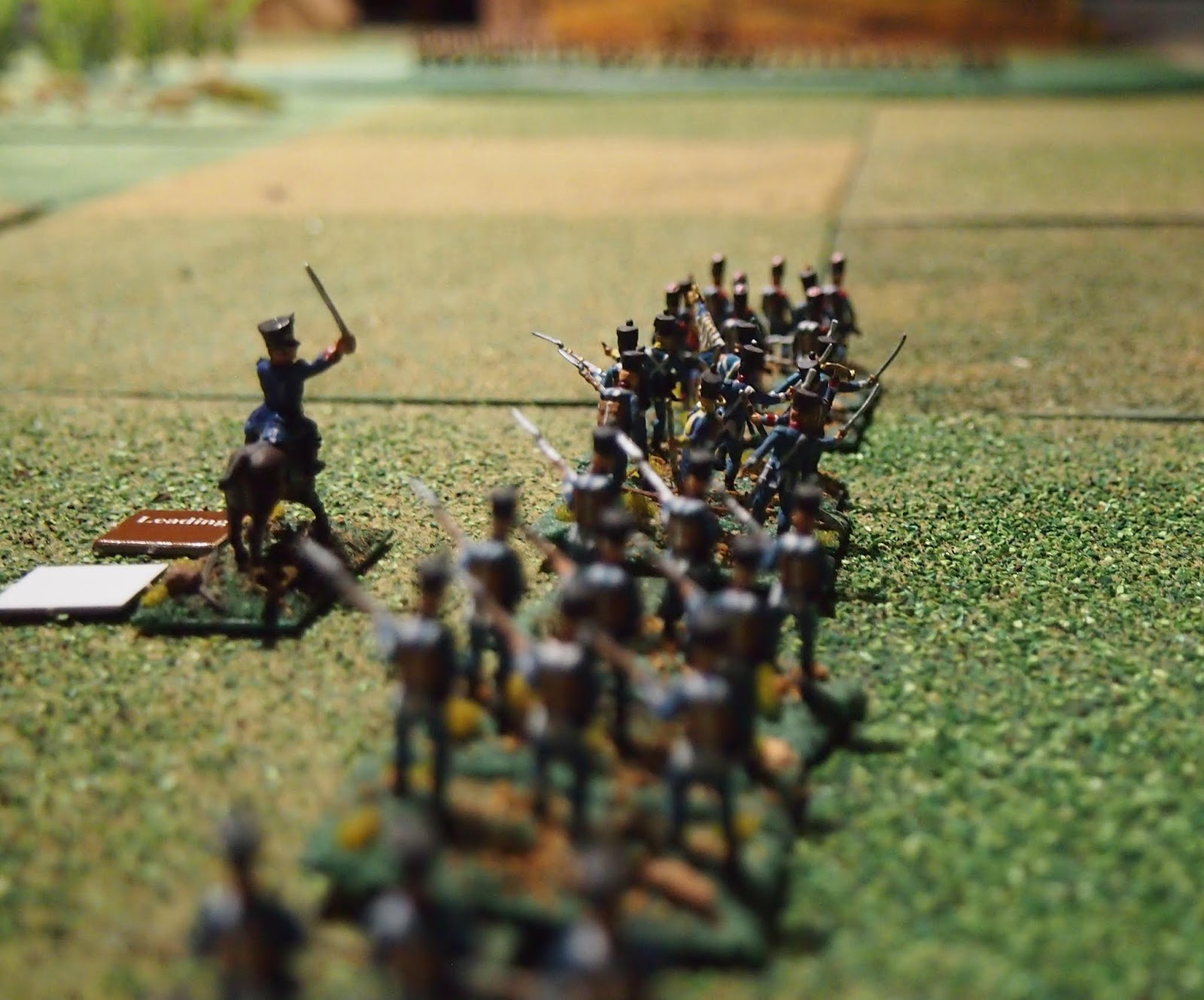
Next turn, the French were off to execute their order intention of 'assault by fire' with the initial action being to change formation (the 'form' part of the light brown counter).


The British activated their order intention of 'defend' and 'prepare and hold' fire order. Defend can be automatically activated if a unit is attacked.


The class and leadership of the French provided three movement dice, which produced a handy 140 yards (14") of movement.


Change formation to attack column duly executed.


On the next turn the voltigeurs were deployed in skirmish and the column advanced. For continuation of the same order intention, the movement allowance carries over (but a player may elect to re-roll).


The British continued to wait and to hold fire.


To provoke them, the French voltigeurs advanced and fired (while the remainder of the battalion deployed into line.


The hit rate from this fire was one per ten elements, so with an equivalent of three elements, this was nothing.


It did, though, force the British to check whether they continued to hold fire; which they did.


The voltigeurs fired again, as the line advanced. Again with no effect from firing,...


and a steady British line holding fire.


The French now changed their order to 'advance & fire', within the same 'assault by fire' order intention.


The British changed to 'fire'.


Both activated successfully as I considered this to be a continuation of the orders already acted upon.


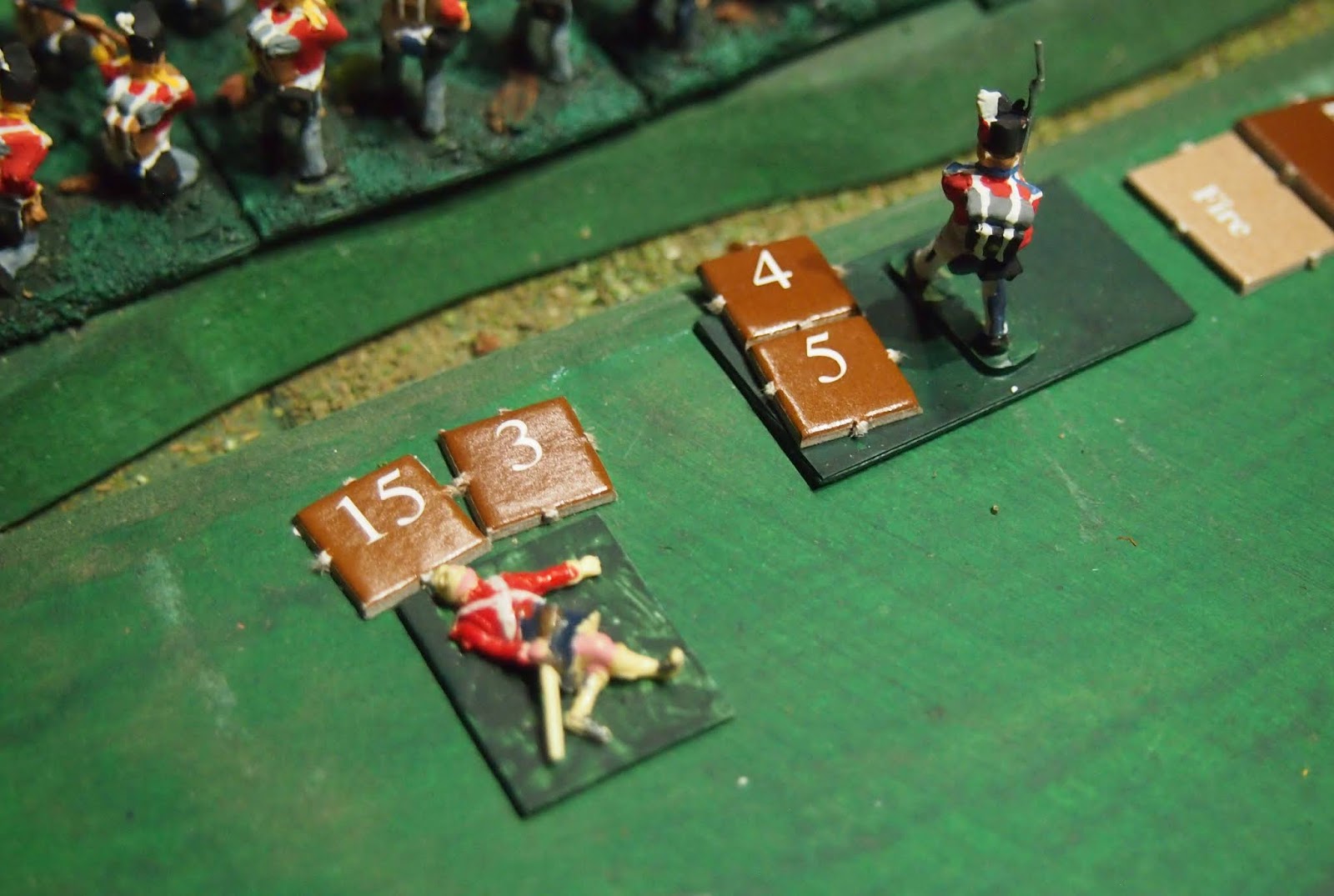
The British fire inflicted one hit per element, resulting in 20 hits,...

... which translated into a 'C' mark (represented by the dead figure from the Ykreol RIP series), plus two further hits (the two 1s) and a single 'D'. I incorrectly added half the hits as Ds, so 10 are indicated in the upper of these two photos (beside the Airfix infantryman carrying his colleague).


The French fire achieved the same result,...

...inflicting 18 hits (indicated beside the dead highlander), but not enough for a 'C' mark. The 'Ds' indicated in the photo (9, a 4 and a 5) were incorrect and should have been nil.


Hits mean that there is a need to check for possible officer casualties.

The French colonel is fine.


The British colonel suffers a minor wound, but manages to stay on his horse!


Both sides passed their morale checks, the wounded officer increasing the likelihood of failure for the British from extremely low, to very low.


Each side was able to remove some Ds at the beginning of the turn, although I should only have used the formation's company commanders (referred to as 'cadre command' in the rules), so had now incorrectly removed too many after having put too many on from the fire!


To fire again, each side began back at the initial, lowest activation level.

Both failed their rolls.


Next turn, the French passed, so got to fire!


The British did not.

This time it was a 'crushing fire', so two hits per element on the British.


Next turn, the French activation was back to the lowest level, no go for them, but the British activated and got to fire. This is only came out as an effective fire.

Another turn on and it was the French who fired.
This time it was a 'beauty', with a 'withering fire'; four hits per element!

So many casualty figures, I had to utilise unpainted stuff.

The British colonel now collected a severe wound (I used a serious wound counter produced for the old Ranger rules). He again remained mounted.

I had been playing the dice as they rolled, so it was amazing how the greater luck seemed to be going to the French. As British commander I considered charging in, but decided to have one more go at firing.


Just as well as it was 'right back at you' with a withering volley on the French! C marks mounting up.

Plus a severe wound to the colonel which unhorsed him. The infantry passed morale, however.


Next turn, the 13th, the French fired with a 'crushing' result.


The British had tried to change order to 'charge', without success on the 13th, but successfully activating in on the following turn.
In they went, won the mêlée, with an 85% chance of victory*, benefitting from extra width of their line and as 'shock' infantry.
*I wondered about this as I typed it, but decided to trust my photos and that I had got it 'right on the night'. I had not. See comments with Peter 'Gonsalvo' below.


A paltry 25% roll for extent of victory saw the French get away with a retreat shaken result, one additional C mark and two Ds.


The French retreated the roll of two D8 dice in inches.


However, the British could utilise an exploitation move and the defeated French were a valid target; "it'd be rude not too"!


With 80 yards of 'exploitation' move, the British easily crashed into the French again, with an automatic victory. Another low victory die roll of 20-odd produced two further Cs and Ds for the French and a further retreat.
(This photo best-illustrates a bit of a problem, viz. the amount of flotsam and jetsam that a unit acquires over the course of a combat. The painted figures look good to me, but I'll have a think about how to show orders, Ds, Cs and officer casualties more neatly.)


I called the game at that point, content that I had a clear outcome of 'British victory'. The final photo shows to me that they will fit well with how I want to use them. This could be translated to a larger-scale game, retreating the French unit, advancing the British (perhaps allowing them to re-occupy the ridge) and adding casualties and/or disorder, depending on the higher-scale rules, to each.

I was also content that it was a sound first test of the rules with which I was most comfortable, nay, impressed and keen to use them for a larger action. The game went for 15 turns which I completed over two evenings, about five hours in total. Not bad as this included checking up on the rules quite frequently during the first few turns, and lots of stopping to take the photos included above (plus several others)!