Wednesday, 23 June 2021

Progress various

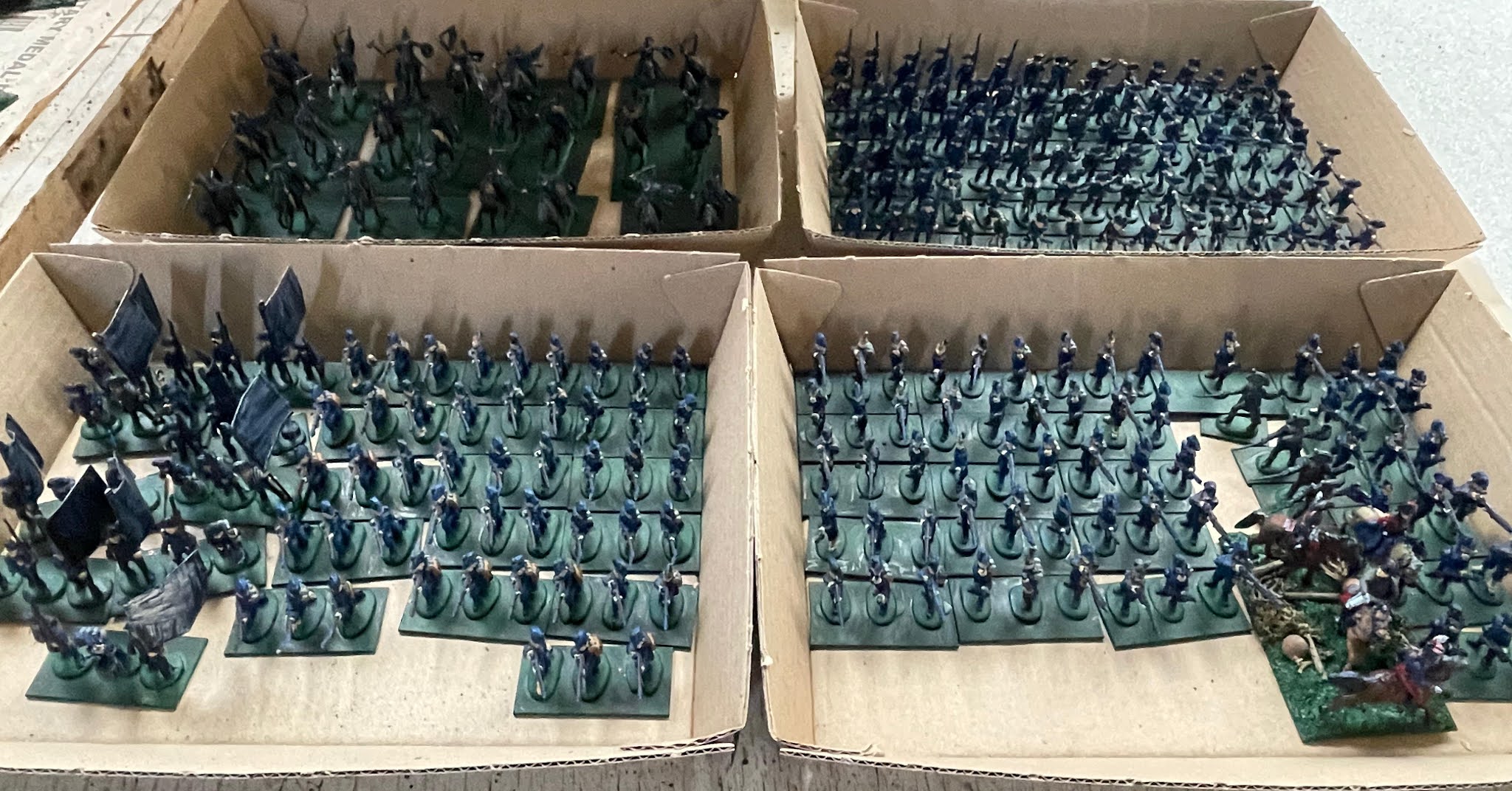
Early Austrians in 1/72 and a more generic version in 2 mm scale are the figures currently getting attention from the brushes chez moi. I recently moved proceedings inside the house as night-time temps have been consistently just a few degrees (celsius, of course).

It has been kinder steps with these Austrians, but they are coming along.

It has turned d@mned cold lately, it don't get much lower here.

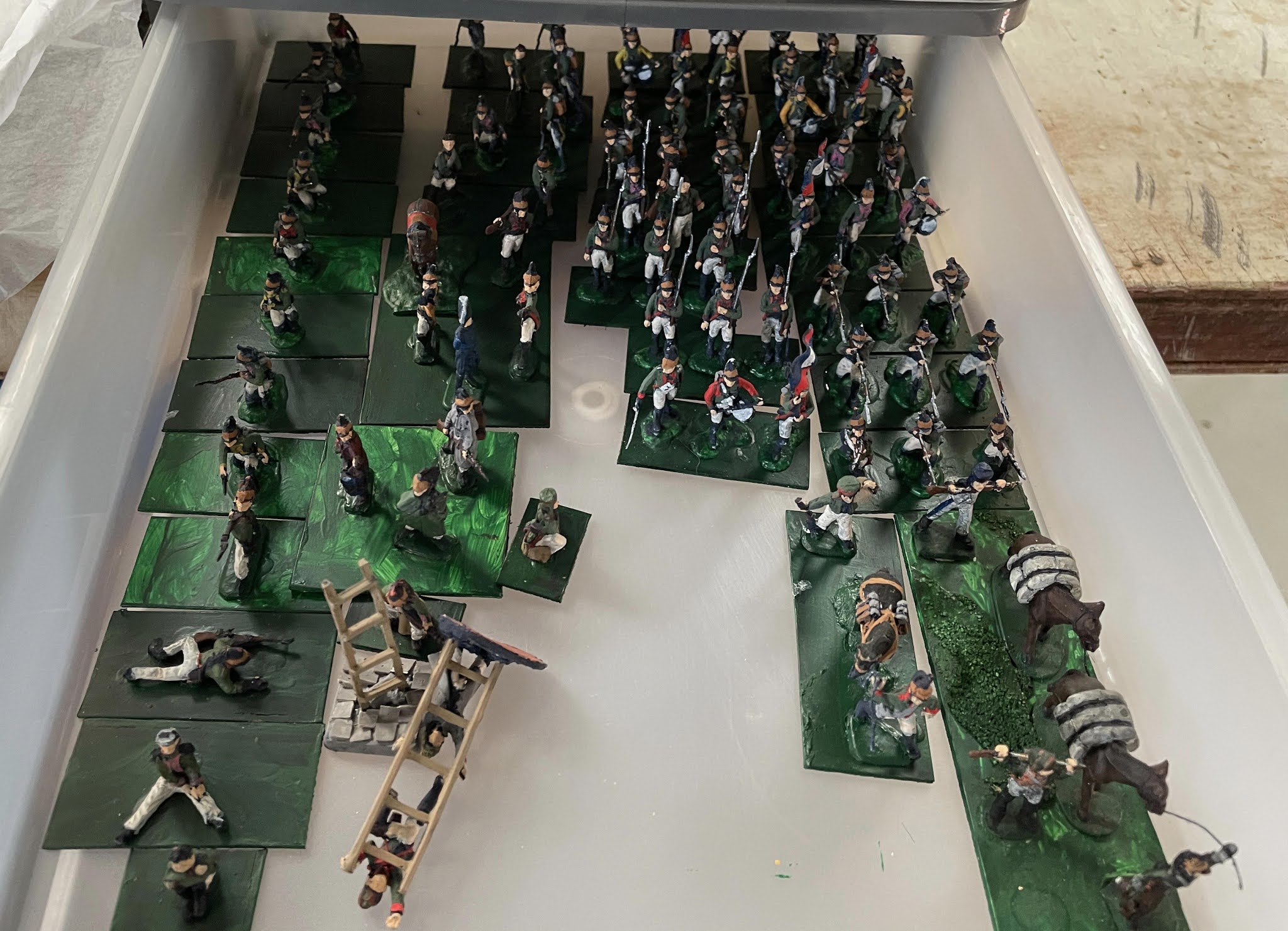
Now that I have completed faces, packs and muskets on the above 216 infantry (and a bit more on their 2 mm counterparts), I am ready to move to the facings, white uniforms and white/blue trousers (a couple of Hungarian regts being amongst them), so will also pick up on the early French that have been waiting patiently for some months!

Early French, patiently waiting their turn for some more colour.

The next four of my '21 Napoleons' are a bit more advanced and will be progressed to completion, with guides and consular guard in tow.

Consular Guard, Guides de Bonaparte and three of my next 21 Napoleons.

Closer look at four of my next 21 Napoleons, which are a bit more advanced.

I also have some figures for later years of the Napoleonic era that will get additions when I have some of an appropriate colour paint dispensed that I want to use up.

French infantry in greatcoats and hats for 1805 (although they likely only had 'liberated' Austrian greatcoats then) to 1807.

Oudinot 'grenadiers' of 1805–07 (infanterie légère).

Oudinot 'grenadiers' of 1805–07 (infanterie de ligne).

Russian infantry of 1805–07.

French dismounted dragoons, chiefly for 1805–07 (although may get a 'run' in the Peninsula).

Assorted, including more Oudinot 'grenadiers' (infanterie de ligne).

Vistula legion, all four 'regiments'.

French infantry in greatcoats and shakos for 1808—15.

At the other end of the production line: more early Austrians in kasketts and figures for future vignettes/command stands for my 21 Napoleons.

We had rain and cloudy days before it cleared up and turned *freezing*, leading to a recent glorius pre-sunrise (above) and sunset (below).


Monday, 14 June 2021

1800 l'ultime année d’un siècle de sang

 The third in the trilogy is available as a pre-order, due for publication in May!


Visit the page dedicated to the book on the Éditions Heimdal website to pre-order, or put it in your 'pocket' to consider once published.

Wednesday, 9 June 2021

Book quickview: 1799, l'année la plus longue

Pre-purchased in September, printed in May, released in June, arrived in our PO box yesterday. The speed with which it reached me after publication was the first of many aspects of this book that have impressed. I have titled this post a book 'quickview', rather than a review, as I have not read it, but flicked through it extensively, over several hours of last night, enjoying each turn back and forth through the pages.

Marquis' earlier work, 1798, Bonaparte et la campagne d'Egypte, joined my collection soon after it was published in early 2020. That book, covering 1798, with particular focus on the Egyptian Campaign (a little over half of its 192 pages) is effectively part one, the current tome being the second part. I was so impressed with the 1798 book, that this one was an immediate purchased. There has been no buyers' regret.


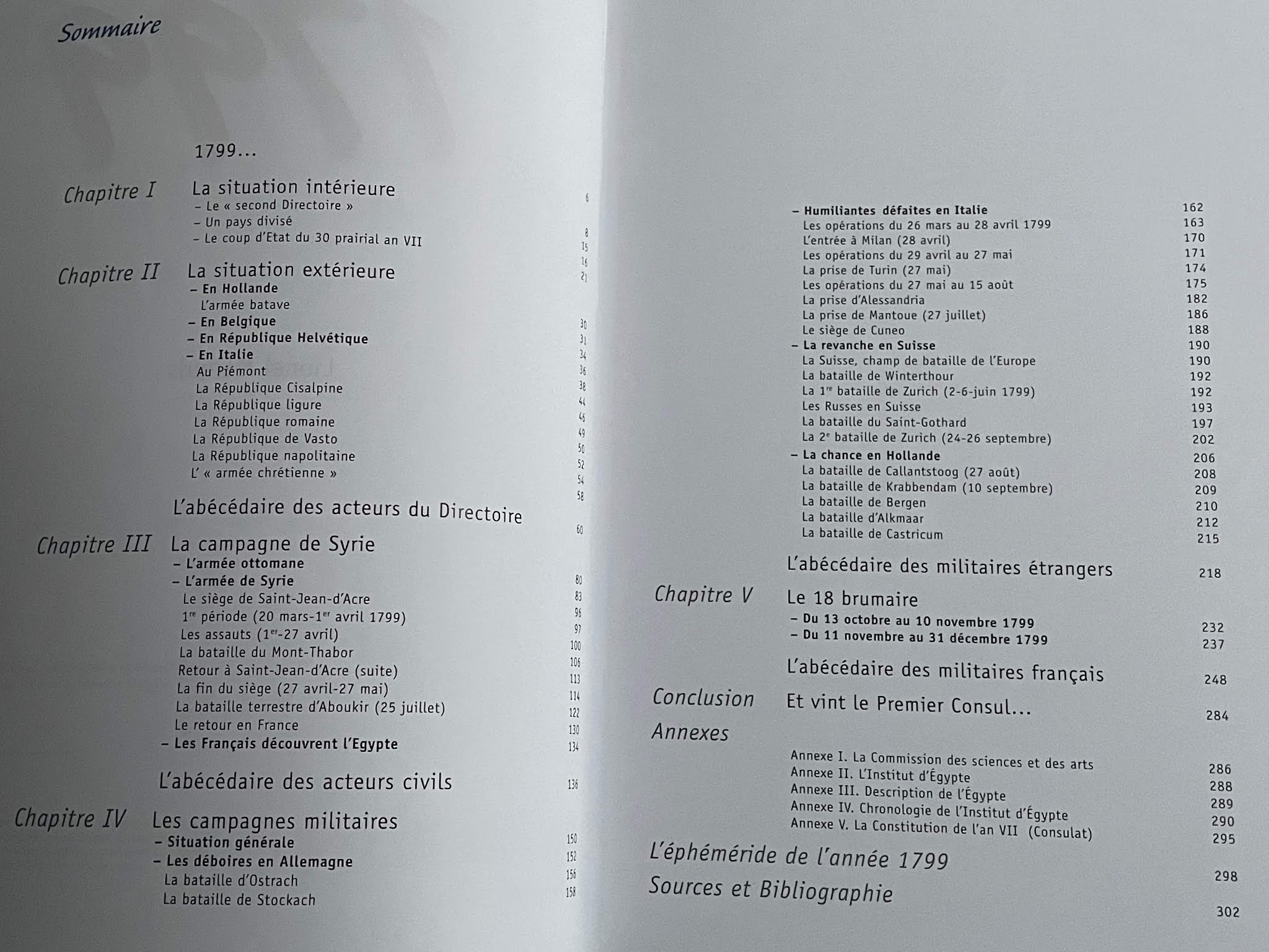
The table of contents
1799, l'année la plus longue is a visual delight. There are images of people, battles, events, troops, uniforms and maps. Many, many are contemporary prints, others are classical paintings (some known and many that are new to me) and quite a number of the cartoons (pen and ink drawings) by Job (Jacques Onfroy de Breville) from George Montorgueil's Bonaparte, first published in 1910—a real treat. All of the images are reproduced clearly and most of them are in colour. Each image has a caption clearly describing it as well as noting the creator and source.

The book is a visual delight, with loads of reproductions of contemporary paintings.

Along with numerous, classic paintings from the late 19th C.

The inclusion of several cartoons from Job are a real treat.

My 'gooey-ness' for this book so far comes from the visual, but even a skim of the book's five chapters reveals the excellent content. They cover France at the start of 1799 (nation, politics and internal divisions), the states bordering France and their armies, the campaign in Syria, the campaigns in Germany, Italy, Switzerland and Holland and, lastly, 18 brumaire. Five appendices round out the book with information about the members of the commission of sciences and arts who accompanied Bonaparte's army to Egypt, the formation and activities of the Egyptology Institute, the full text of the new constitution that was proclaimed in Paris on 15th December and a chronology of the year 1799.

Several double-page and near double-page spread paintings of battles are presented.


The book is not a uniform book, but loads of lovely images of troops of all nations adorn its pages


In various chapters there is information about the armies, strength, organisation and make-up down to the unit level. This is complemented by orders of battle that are dotted throughout; in appropriate locations related to the battles under discussion. The third and fourth chapters covering the vast number of battles that occurred in 1799 includes information about the leaders, movements and numbers of troops, with some actions described in great detail (e.g. the Siege of St John d'Acre, Battle of Mount Thabor, Battle of Aboukir, Battle of Ostrach, Battle of Stockach, Capture of Alessandria, Battle of St Gothard and first and second battles of Zurich).

A real bonus in the book are the 77 pages of biographies of the main people associated with the events of the year. These are divided into the key actors (political and military); non-military people; Austrian, Russian, British and Egyptian-Ottoman generals and French generals. These biographies are inserted, a group at a time, between the chapters. For each person we are given their place and date of birth, date of death and biography up to 1800 (or sometimes a little later).

The 77 pages of biographies were an unexpected inclusion and a real bonus to me.

Several tables of orders of battle are included.

Maps are probably the book weakest point, but there are several showing regions, places, specific events and battles


I'll read this gorgeous, hefty and beautifully printed book properly and in its entirety in time, as my chronological approach dictates. For now it is a joy to leaf through, looking at the plethora of piccies, reading the captions and dipping into the text. A delight to have on the shelves.

I thought that I'd conclude with this photo of a full-page reproduction of a Maurice Orange painting of French soldiers sampling the delights of the Orient!

Rating


References

Marquis, L (2021) 1799, l'année la plus longue. Éditions Heimdal, St Martin-des-Entrées, Bayeux, France. 304 pp.

Marquis, L (2020) 1798, Bonaparte et la campagne d'Egypte. Éditions Heimdal, St Martin-des-Entrées, Bayeux, France. 192 pp.

Thursday, 27 May 2021

Book review: La Campagne de France, 1814

When I ordered this book back in February, I thought that it was a history of the campaign of 1814, chiefly from the French side. How mistaken I was. It is quite different and far, far more delightful, useful and insightful for the fact!

Author Gilles Boué describes each arm/formation of the French army in 1814 against the backdrop of the campaign and battles. He provides details of formations, events and actions, interspersed with anecdotes, observations and challenges to myths. The book is 'lusciously' illustrated with some of the well-known paintings of the mid-18th and early 19th centuries, along with some more recent examples, drawings and loads of uniform prints. These are all beautifully, crisply reproduced—the vast majority in colour.

The first two chapters describe, respectively, the lead-up to the campaign (a sort of ‘story so far’) and brief description of its course from February to April 1814. The bulk of the book is dedicated to the troops who made up the French army of 1814, answering Boué’s own question posed in the opening chapter; “Qui étaient-ils?” (Who were they?).

Two examples of the beautifully reproduced paintings that adorn the book. The last halt of the Cossacks before the invasion of France (above) and Charge of the Guard Cossacks at Fère Champenoise (below).
[Note: I didn't twig until adding this caption that I just happened to choose these two, both involving Cossacks!]


Above and below: examples of pictures related to troops and uniforms.

There are chapters about the levée and conscripts, the Imperial Guard, the cavalry, the infantry, the national guard and the free corps (local peasant ‘units’ and those made up of stragglers and other ‘lost’ soldiers). For each of these Boué describes the formation, establishment, regulations, arms and equipment (that there were, particularly for the conscripts and National Guard) as well as examples of their performance in key actions with specific numbers, dates, and names, losses, successes and failures. The specific structure of each chapter is slightly different, but for each the text is rich in detail, examples and anecdotes.

One of the numerous tables in the book. This one the only example that fills two pages!

The numerous ‘sidebars’ and tables presented include a list of the main battles, maps of fifteen of the key ones and detailed orders of battle (for the French). These are complimented by additional information such as a list of revenues, effectives in garrisons, units in reserve camps, table of levees 1804–1814, pay for troops of different ranks and units, along with the cavalry regiments and numbers of men in each joining the army over the course of dates in February—to list about half of it—making for a book packed with excellent content.

Map of the Battle of Champaubert, one of fifteen presented.

The French text is quite easy to read, even for someone like me with only an intermediate grasp of the language. My French vocabulary is quite limited, but I hardly needed to go to the dictionary. I have been reading a bit of French lately, so perhaps have my ‘eye in’ a little, but would certainly not claim any fluency. If you have no knowledge of French I’d still recommend the book as the images need no translation (a picture tells…) and the tables can be comprehended largely without translation, so you’d still get value from the book.

Highly recommended. A most useful, unique, detailed, comprehensive and beautifully produced addition to books about this campaign.

Rating


Reference

Boué, G (2021) La Campagne de France, 1814. Editions Soixante, Paris. 176 pp.

Wednesday, 5 May 2021

Napoleon 200 2021: vingt-et-un Napoleons (1) La Mort de Napoleon

For some time I have had in mind to produce a range of representations of Napoleon, some as command bases and others as vignettes. Since we are in 2021, the very last of the Napoleonic bicentennial years, I have the impetus to make it happen.

Each of my representations will be based on or inspired by a famous painting.

On this two hundredth anniversary of the death of the Great Man, I have begun at the end with La Mort de Napoleon. This is inspired by the painting by Jean-Baptiste Mauzaisse of Napoleon on his death-bed, one hour before his burial.

Napoleon sur son lit de mort une heure avant son ensevelissement, by Jean-Baptiste Mauzaisse

My version of same.

I am not much of a modeller, but enjoy 'having a go' with the materials that I have to hand. In this case Napoleon's upper body, head and arms are from a Strelets figure (nominally of Joseph, but which, naturally, can easily be either he or Napoleon) while his legs I made from Das modelling clay. Marchand was created using one of the figures from the Imex Stagecoach set and the priest using the body of the lady from the same set (Das clay making up the rest of both of them). The bed was a matchstick and cardboard frame with liberal addition of Das clay.

I am happy enough with how it turned out—although my version of Marchand looks like he belongs on the set of Saturday Night Fever! I considered adding a frame and canopy to the bed, but was not sure how I would do it (and was worried how it might look), plus it meant extra effort for not much benefit and likely detraction. In the end I was swayed by a simpler version which better matched the painting.

So, that's one down and twenty to go.

The next twenty will be in a chronological order, beginning with 1796. Some years will get multiple representations while others won't have any. I want to get them all done this year and with 34 weeks remaining, I can't muck around.

I am pretty confident that I'll get them done as the next three are well underway and four of the later ones are completed or very nearly so.

The next three Napoleons 3/4 done
 

Once completed these representations will be invaluable for my long-term focus on the quasquibicentennial / vigbicentennial (225th and 220th anniversaries) of campaigns from 1796 to 1815, which began this year.

Sites of interest

1. The wonderful website of the Foundation Napoleon (napoleon.org) has a page entitled La Mort de Napoleon that is packed with links to articles and images (including the painting above).

They also have numerous events and articles for 2021 Année Napoléon.

2. Shannon Selin's blog on her website 'Imaging the bounds of history' is packed with thoughtfully produced articles about the Napoleonic era. I cannot recommend it too highly.

Her 'back catalogue' features several posts related to Napoleon's death including:

What were Napoleon’s last words?

How was Napoleon’s death reported?

Saturday, 10 April 2021

Missing the tree in the forest

I am so focussed on my structured activities1 for the quasquibicentennial of the battles of 1796–1800 (to be followed by the vigbicentennial of 1805–15), as well as other anniversaries in 'les autres periodes', that I completely missed one this year; the bicentennial of Napoleon's death (5/5/212)!

Mort de Napoleon, Steuben (Wikimedia Commons)

Thanks to 'Marius' over at Un Marius sinon rien! for bringing it to my (our) attention and for this marvellous post seeking to introduce the period and the wargaming of it to others.

Bravo 'Marius'!

1Good old serendipity strikes again, having chosen this year to begin the focus of my activities on the anniversaries.

2That date works whether you are reading it my way of the US style.

Sunday, 7 March 2021

A new Napoleonic podcast: The Napoleonic Quarterly

Thank you to Phil at Lair of the Green Tiger for making me aware of this excellent 'new' podcast.


I put 'new' in quotes as the first episode was released in January of this year. There have been seven to date, each one exploring key events in a quarter of a particular year, commencing with the first quarter of 1792.

The podcast has been produced by Alexander Stevenson, an English journalist who is unknown to me, but whom I gather has the day job of following contemporary politics and is a fellow 'history buff' in his spare time. The podcast is summarised thus;

Taking the epic conflicts of the French Revolutionary and Napoleonic Wars three months at a time. Each episode features interviews with leading historians of the period, covering the campaigns, diplomacy and political dramas of an extraordinary 24 years.

Here is a link to the introduction, should you wish to listen to it. You'll hear that he plans 12 seasons covering two years each. Each episode is planned to comprise an introduction, in-depth interviews and a panel discussion summarising the content.

My assessment of 'excellent' is based on the first episode in which guests including Alexander Mikaberidze, Charles Esdaile, David Andress, Paul Dernet, Jacqueline Reiter discussed Europe on the brink of war, a pocket history up to January 1792, political aims of the various states, machinations and what the 'real' war aims may have been. They pack a lot into an hour such that I could likely listen to it again—except that I am keen to proceed to episode 2!

Check it out for yourself on your favourite podcasting service.