Thursday, 25 August 2022

Books, glorious books

I really, really like books; particularly those about military history, most particularly if to do with the Napoleonic era, even more if about campaigns or uniforms and especially when beautifully presented, hard-bound tomes!

I have bored readers previously by noting that, if forced to chose, I'd take my books over my figures. Any time. Of course, I am in the fortunate position of not having to, so it's a bit like the 'game' of considering which sense you'd 'prefer' to lose (although far, far more trivial, of course). But then, loss of any of the senses would impact my ability to enjoy books or figures to the extent that I can at present. Enough of that digression...


I recently had a quadruple dose of material delight when I ordered two special books, published by Le Livre Chez Vous (Éditions du Quotidien)#, which, due to an 'administrative error', became four. More on doubling later, but firstly to the two that I ordered:

(#Le Livre Chez Vous publish a range of titles, including a large catalogue on the Napoleonic period and the magazines 'Gloire & Empire' and 'Soldats Napoleoniens'. Sadly, their website has been being renovated for some months now. They provide links to resellers stocking their books, which is how I came to the shop of L'Est Républicain and these books).

Napoléon en Pologne- La campagne de 1806-1807, and
Napoléon en Autriche - La campagne de 1809 - Les opérations du 24 avril au 12 juillet.

These are particularly glorious, beautifully presented, hard-bound tomes.

The visual and tactile first impressions are sheer delight, thanks to the A4 format, heavy stock, beautiful layout and plethora of colour pictures. Examples of the latter appear on every page. The text includes a description of events of the campaigns/phases indicated by the titles with numerous quotes from eyewitness accounts (based on reports and memoirs—more on that later too). I have leafed through the pages, reading sections here and there so cannot yet comment in detail on the text. I can say that they are both well-written, in an interesting, story-telling style and in French that is easily comprehensible to me with my intermediate level.

Some sample pages from "Napoléon en Pologne" will serve to illustrate.


Three examples of the pages showing layout and illustrations. Every page includes illustrations. The majority of these are in colour and show personalities, actions, units, photos of locations and items of uniform from museums. I had only seen a handful of the illustrations previously: the 'famous' ones and some from the issues of  'Gloire et Empire' magazine covering this campaign.


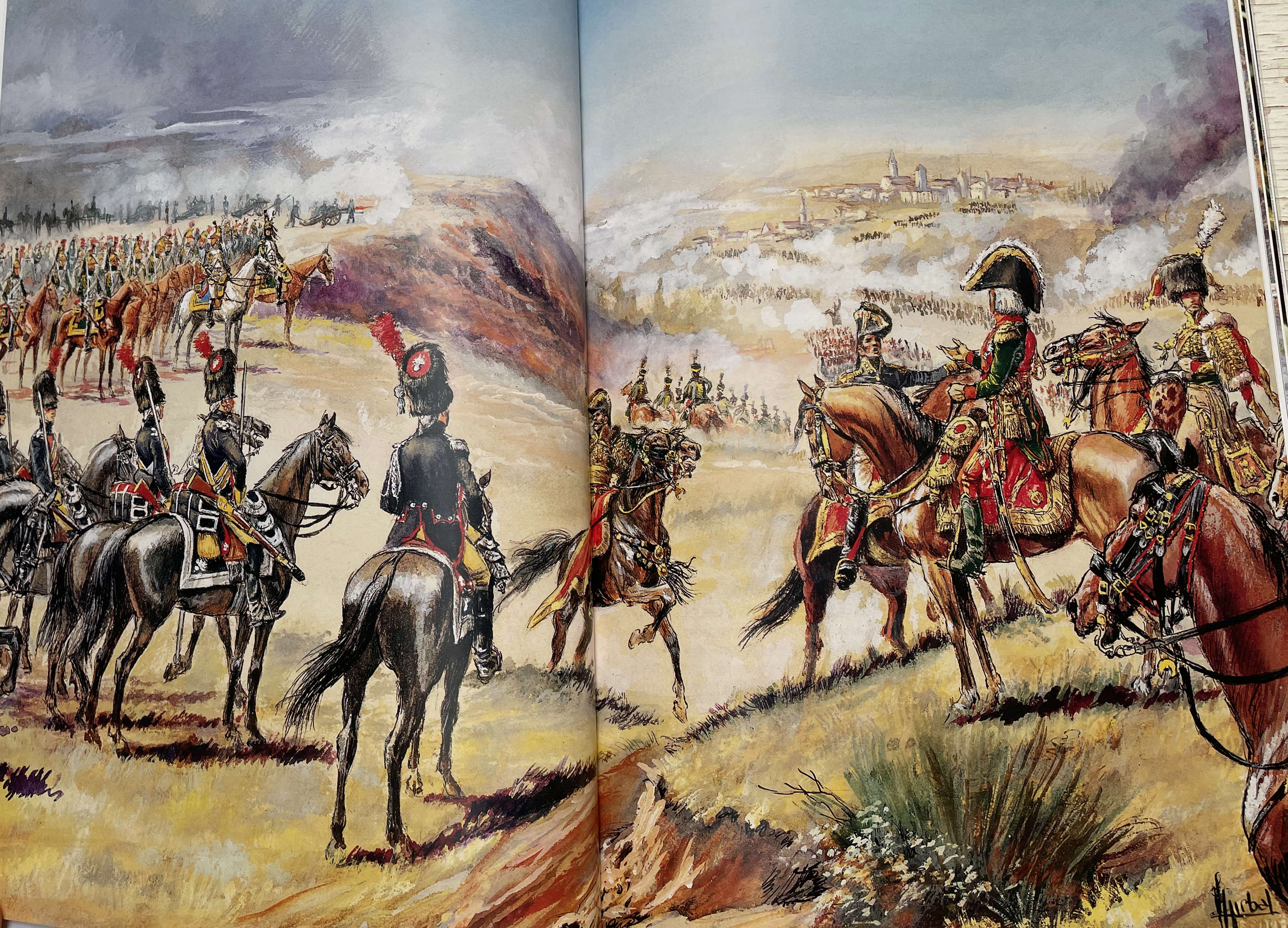
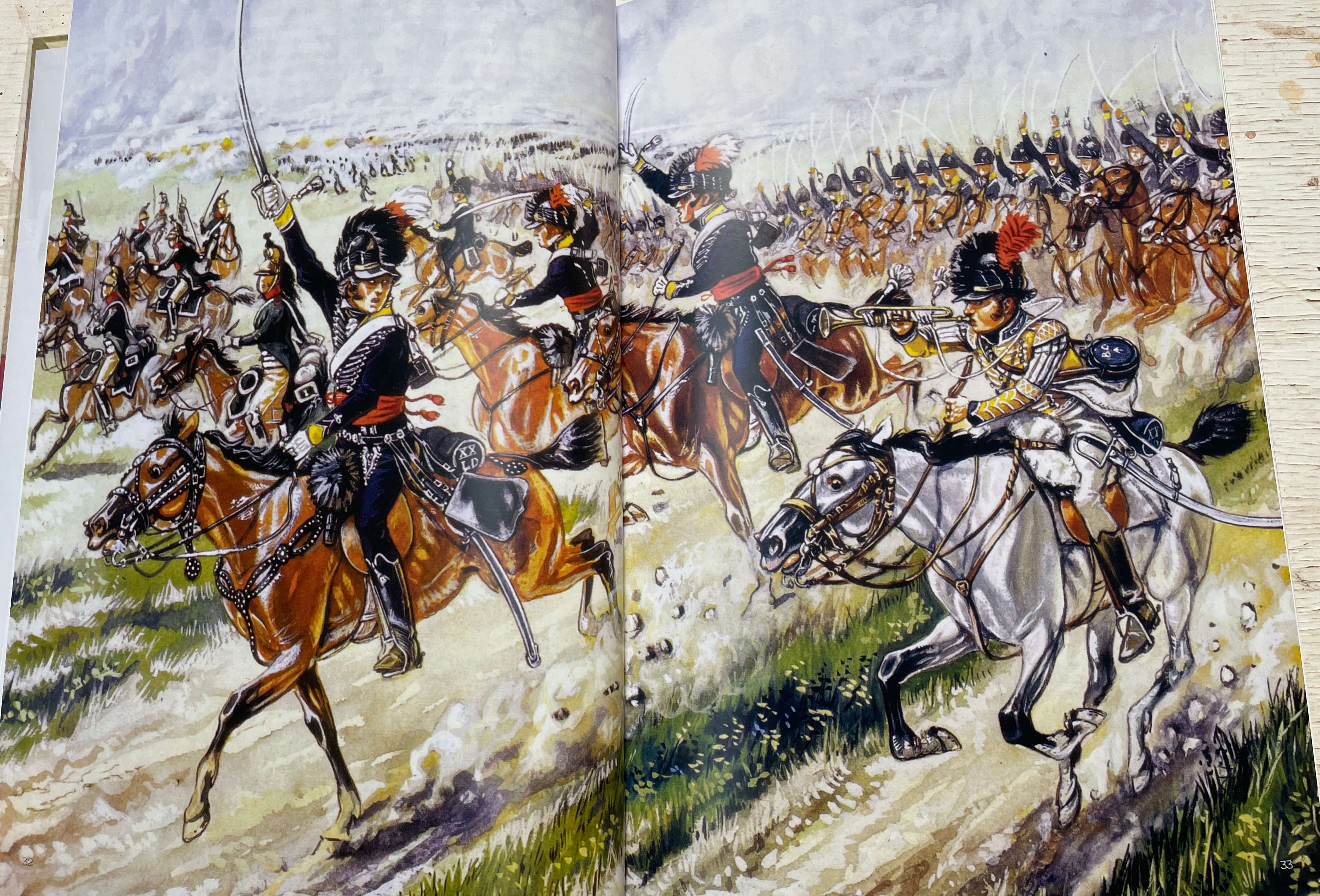
Several pictures are presented as a double-page spread.

I found this view of Friedland and associated contemporary photos really interesting and they will be useful the next time I attempt to recreate the battle.

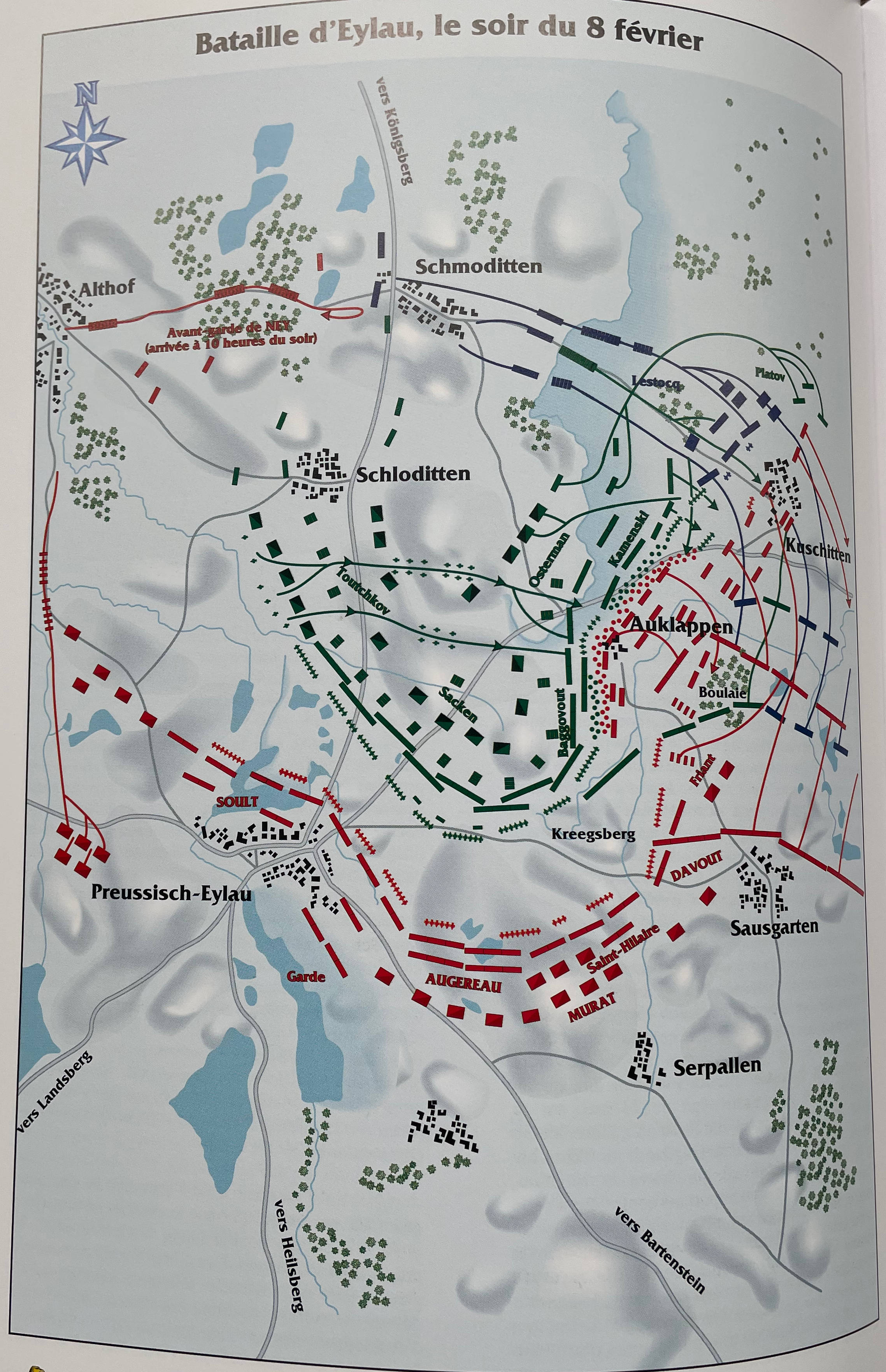
The book includes numerous maps of two types: some showing the distribution of forces and key geographic points at different stages of the campaign and others illustrating battles. The maps are colourful and clear, but only those of the overall campaign have a scale indicated. This is so frustrating. Why do publishers/authors do this?!!
I particularly liked the 'snow' landscape of this map of Eylau!

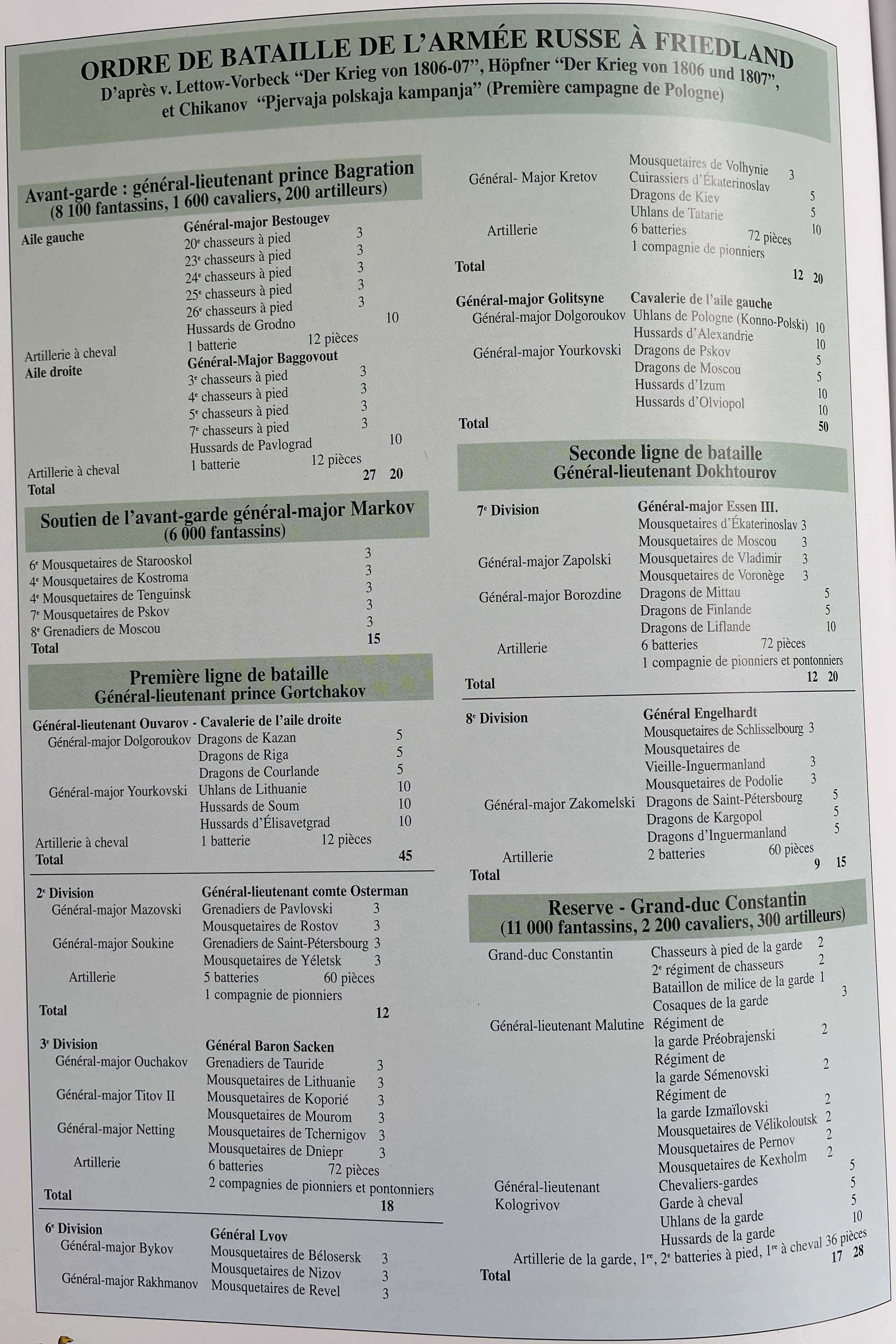
Orders of battle are provided for the three armies, French-Allied, Russian and (where appropriate) Prussian at the outset of the campaign and for each of the key battles (Golymin, Pultusk, Eylau, and Friedland).

I learn something everyday, even about topics of which I think I have a reasonable grasp.
I have read a lot about the campaign of 1807, but was not previously aware of this incident at Friedland of fire from horseback from the French dragoons against the charge of the uhlans (and one squadron of Lifeguard Cossacks). In the book there is a quote from Grouchy praising the action of the dragoons, but, unfortunately, no great detail. I found more about the incident on the 'Napoleon, His Army and Enemies' website which quotes cornet F. V. Bulgarin of Grand Duke Constantine Uhlans who says that the "...French dragoons halted and stood motionless like a stonewall [kak kamennaia stiena] waiting for the enemy... the second rank grabbed their muskets and began firing while those in the first rank drew sabres and waited. The charging uhlans first slowed down and then halted. The French sounded massive “En avant ! Vive l’Empereur!” and advanced forward en masse. The uhlans and Cossacks gave way before the sheer weight of the column."

In the foreword to the book, the authors, Natalia Griffon de Pleineville and Vladimir Chikanov, note the paucity of material about the 1807 campaign in Poland. They highlight the challenge of relying on 'eyewitness' accounts that were often written long after the events and as justification for the author's actions, in the politics of the day and/or simply with the reminiscence of older age. Their approach has been to utilise official publications of the day (which also have their limitations, as they note), along with selected quotes from French, Polish, German and Russian sources. The result, from my skimming, is a rich and vibrant description that was/is a great addition to available books about the campaign prior to its publication.

The book is organised in forty, brief/shortish chapters (a format that I like as it suits my 'bite-sized' approach to reading) plus several, detailed appendices covering military decorations and awards, a reproduction of Victor Hugo's 'Cimetière d'Eylau' (his father was an officer in the French army in the time of Napoleon), place names in 1807 and today, all of the proclamations and bulletins of the Grande Armée during the campaign, the acts signed at Tilsit, bibliography and index of names. It's a beauty!

I look forward to reading it in detail.

Error in my favour

I had been interested in "Napoléon en Pologne" since first seing in on the Le Livre Chez Vous website a few years ago. It sounded great, but the list price of €145 was far outside my budget! I took the plunge when I followed the link on the 'under construction' website of Le Livre Chez Vous to the website of L'Est Republicain and saw that the price had been reduced to €45 . I enquired about it along with the volume covering the second part of the 1809 campaign. It would still be a big purchase, since postage was near the price of the books, but the description of the quality of the publications, the involvement of Natalia Griffon de Pleineville and past experience with publications for Le Livre Chez Vous convinced me they'd be worth it.

I was super excited when, early in July, just eleven days after making payment, my wife said that she'd collected a large, heavy package for me. My delight changed to confusion when I opened the package and saw neither of the books that I'd expected. Instead, two of the others that I'd considered were contained therein:

"La bataille de Taroutino" and "La bataille de Polotsk".

I contacted L'Est Republicain immediately. They replied promptly. The books had been sent in error. Mine would be sent to me, although there would be a delay as they were taking holidays from Bastille Day until early August. What to do with the ones that I had received?

I had not opened them (they were wrapped in plastic), as they were not mine. There was a bit of toing and froing. They offered to me to purchase them at cover price only (i.e. without the cost of postage). I thought about it, but since I had already made a big purchase I was not keen on another. So, I offered to return them if they sent me the cost of postage. They declared that the cost of returning them was prohibitive and so I could keep them. It was then that I removed the plastic covering and looked inside.

Wow! They were beautiful. Some pages from La bataille de Polotsk will illustrate.
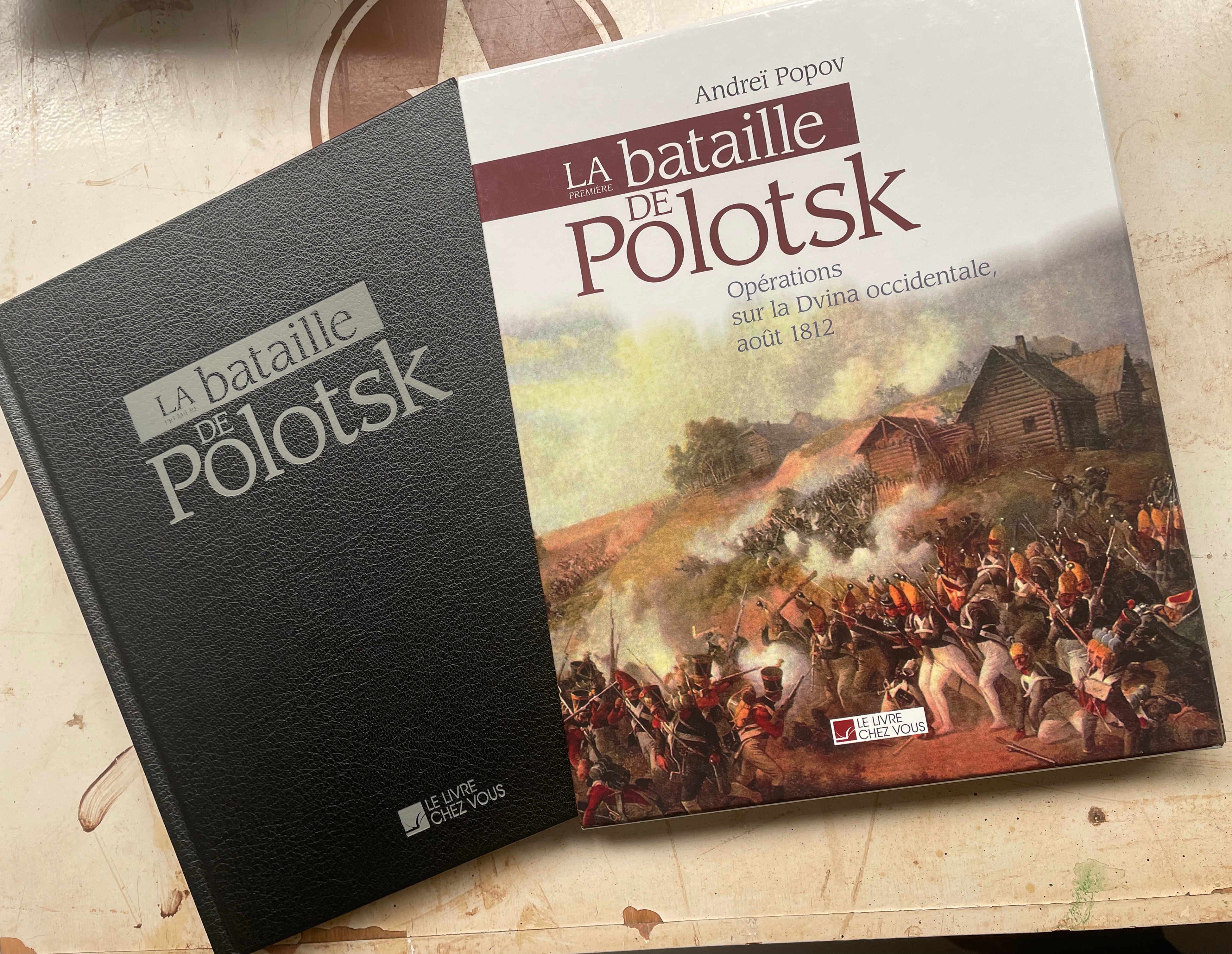
The books come in a rigid case and have a lovely, textured, pseudo-leather (vinyl) cover.

Like "Napoléon en Pologne" and "Napoléon en Autriche" (which, of course, I saw later) they are lavishlly illustrated with the same range of quality images (most not seen previously by me).

Not every page has illustrations, but the text is a clear and pleasing font, written in French that is accessible to me, providing a lot of detail and including quotes from Bavarian, French and Russian eyewitness accounts.

Several, beautiful illustrations of uniforms by A. Yejov are presented.

This painting by Peter von Hess, which graces the cover of the case and is an example of the few, known to me, more 'famous' ones that are in the book, is reproduced inside with a detailed and useful description.

Some paintings are reproduced as double-page spreads, in equsite detail/quality.

Another beauty by Yejov. The caption for this one erroneously notes the cuirassiers as being from the 2e regt. The Russian hussars are indeed the Grodno regt and it is pleasing that the artist has shown them in dolman only. While I prefer my wargaming Russian hussars in all their splendour of dolman and pelisse, it is more accurate to them in dolman only. The pelisses were left at the depot to make the weilding of the lances easier.

Numerous maps illustrate the series of battles that comprised the campaign within a campaign that was the first and second battle of Polotsk. Like "Napoléon en Pologne" above, there two types of maps: those showing the overall campaign and those showing battles, but only the former have scales—arrrrrgh!!

Orders of battle are presented in the appendices

"La bataille de Taroutino" follows the same format and is equally fabulous.

These were a real windfall and it was like that "bank error in your favour" card in Monopoly. Having opened them and seeing how lovely they were, it felt a bit strange to have received them for free. It did not sit well with me and felt dishonourable. So, I have paid for them and now feel that I have legimitate copies.

Painting progress—not much, but...

I posted on my non-Napoleonic blog about the lack of much progress with painting over the past couple of months. I expect that to change over the next two to three months, so reckon I'll have the early Austrians illstrated below, and a few others, marching out the other side of my 'active' painting queue.

All of the horses need painting on these early Austrian uhlans (Mészáros regt) and grenz hussars (along with the Polish-Italian legion lancers); then all colours for the base coat will be completed.

The Gyulai Freikorps (made from converted Airfix and Esci Royal Horse Artillery gunners) are ready for basing material, black-wash and then highlights. The early grenz, converted from Hat later grenzer, need mobs of white since "even the black bits [belts] were white" in 1796.


References

Bessonov, V (2010) La bataille de Taroutino. Translated by N Goutina. First Published 2008. Le Livre Chez Vous, Paris France. 165 pp.

Cavalry Tactics and Combat Napoleonic Wars (Parts 2 and 3). Napoleon, His Army and Enemies website. http://napoleonistyka.atspace.com/cavalry_tactics_2.htm#_and_cavalry_battle_at_Friedland_2

Griffon de Pleineville, N and Chikanov, V (2008) Napoléon en Pologne- La campagne de 1806-1807. Le Livre Chez Vous, Paris France. 610 pp.

Molières, M (2004) Napoléon en Autriche - La campagne de 1809 - Les opérations du 24 avril au 12 juillet. Le Livre Chez Vous, Paris France. 600 pp.

Popov, A (2013) La bataille de Polotsk : opérations sur la Dvina occidentale, août 1812. Translated by N Goutina. Le Livre Chez Vous, Paris France. 173 pp.

Wednesday, 13 April 2022

Mini Book Review: Chargez! La cavalerie au combat en Espagne, Première époque, 1808-1810 by Natalia Griffon de Pleineville

I pre-ordered this book on spec. Prior experience with recent publications from Editions Soixante (L'Esprit du Temps) and of previous works by the author lead me to have no hesitation in placing an order prior to publication—with have high expectations about it. The book having arrived yesterday, I am really pleased to have made that decision—my expectations have been exceeded greatly!

Natalia Griffon de Pleineville was the editor-in-chief of the marvellous magazine Gloire & Empire and has written several books about the Napoleonic wars. I have an English-language version of Chiclana-Barrosa 5 March 1811: The Eagles in Andalusia from Les batailles oubliées (Forgotten Battles) published by Historic’One, which is a small, but detailed and really useful book. Those two threads of her past work—quality and visually beautiful work about topics that are less-well covered in the general Napoleonic literature—are in clear evidence here.

My first, wonderful surprise on opening the book was this dedication, handwritten by the author. Presumably, included for purchasers of the pre-order version.

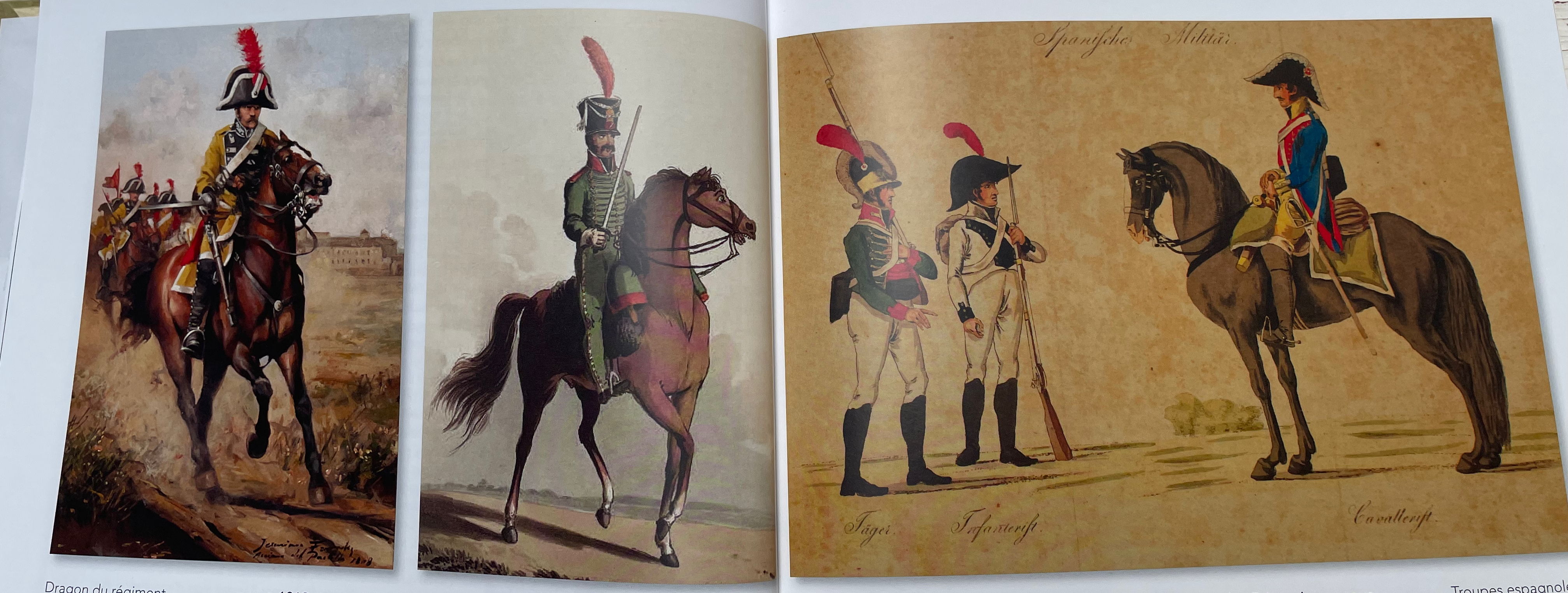
In Chargez!, Dr Griffon de Pleineville describes and discusses major battles, small actions and skirmishes of the first three years of the Peninsular War from the perspective of the role and actions of the cavalry. Units of cavalry of French, Polish, German-allied, Spanish, British, King’s German Legion and Portuguese all feature; sometimes in victory, other times in defeat, in advance and retreat, as advance-guard or rear-guard, charging across a battlefield or supporting infantry.

The book begins with an overview of the cavalry of the Peninsular war, both French-allied and their opponents. Subsequent chapters are divided into campaigns and/or theatres of the war between 1808 and 1810, viz.: Vimeiro; Cabezon and Medina de Rioseco; Gamonal and Somosierra; Sahagun; Mayorga, Benavente, Mansilla de las Mulas; Ciudad Real and Medellin; Talavera; the bridge at Arzobispo and Almonacid; Tamames, Ontigola, Ocaña and Alba de Tormes; Gallegos and Barquilla. Each chapter covers the battles and actions of its title as well as other, smaller actions in the same period/theatre of the war.

The text of each chapter is supported by copious illustrations (the majority in full-colour), maps, photos, side-bars and orders of battle. The former are quite glorious and include both older and more contemporary prints by the likes of Bucquoy, Rousselot, Detaille, Dighton, Kossak, Job, Wollen, Gros, Philippoteaux, Knötel, Martinet, Girbal, Courcelle, Churms, Rocco, Hook, Jouineau as well as loads of assorted prints and artists from the Anne S.K. Brown collection. Many of the prints that are reproduced are now in the public domain, but I always appreciate quality, printed versions over digital. A real treat for me are the sections of a diorama of Somosierra by Wojciech Kossak that I have never seen before and are present as two-page spreads.

Above and below: examples of the copious illustrations in the book


Best of all for me are two reproductions of sections of a diorama of Somosierra by Wojciech Kossak.***

The maps in the book are numerous and clearly reproduced. These good aspects are completely undermined by the lack of a scale on most of them. This is despite the original maps having one. Why, oh why do books so often stuff up with the maps? It is so frustrating!


Above and below: some of the maps presented in the book. Clear reprints, but sadly most of them lacking a scale, despite one being present on the original! 


Each chapter includes several of the author’s excellent photographs of the battlefields today. These are interesting, edifying and really useful if one wishes to reproduce the terrain on the tabletop. Fortunately, they show sections of battlefields that are relatively intact, so one can translate them to the early nineteenth century, rather than of modern forests, roads or other constructions that leave it all to the imagination.

Two examples of the author's photos of battlefields that are included.


Side-bars about personalities, units and actions are dotted throughout the text. I enjoy these as they provide the sense of ‘bonus’ content!

One of several side-bars; and related illustration.

Each chapter also includes orders of battle for the cavalry formations involved in the actions described. Again, these are really useful for wargame purposes since they are at unit level and include numbers of combatants.

A sample of the orders of battle included in the book.

Since opening the package earlier yesterday, I have leafed through the book, back and forth, reading captions of images and a paragraph here and there. I also read one of the chapters, in order to give this mini-review more ‘meat’ and to avoid it being focussed entirely on the ‘pretty pictures’ and look and feel of the book.

I selected the chapter entitled ‘Talavera Juillet 1809’, since the battle and campaign of Talavera is one of several in the Iberian Peninsula that I have a strong background knowledge about. I have read about it in numerous books about the war overall, relatively recently read and reviewed Andrew Field’s excellent book on the subject and have designed and helped to design scenarios so as to play it out on the tabletop twice.

If this chapter is indicative of the rest of the book, then I am in for a treat when I read it in its entirety. Griffon de Pleineville’s tells the story of the battle (and more besides) with engaging, detailed and eminently readable prose. Quotes from the memoirs of participants form both sides are weaved in beautifully with her text. While the focus is on the cavalry, she describes the battle in its entirety, including the French night attack of 27th July on Cerro de Medellin. The cavalry actions of the battle (which were few in number) form the bulk of the chapter, beginning with the skirmish between Milhaud’s dragoons and the Spanish in Talavera on the 27th, moving to the 28th with the charge of the Spanish Rey Cavalry Regiment “…often cited as the best exploit of Spanish cavalry in the entire war” (p. 215, my translation) and the charge of the British/KGL light dragoons against the French outflanking manoeuvre in the north. Dr Griffon de Pleineville includes details of regiments, numbers of troopers, movements, casualties and results—all excellent grist for a wargamer’s mill. Similar detail is provided earlier in the chapter, which begins with the second French invasion of Portugal under Soult. In describing their ejection by Wellesley’s army Griffon de Pleineville includes quite detailed descriptions of the rearguard/vanguard actions around Grijo and Tage before telling of subsequent events leading to the battle of Talavera.

One pre-orders a book based on the description provided at the time, but not actually knowing the content. Such was the case with this book which experienced a few delays in publication and some changes to the content.

I pre-ordered my copy in August 2021. At that stage publication was scheduled for the end of the year. It was initially delayed until January and then eventually completed in February 2022, with printing in March. Of course, changes from projected to actual publication are not surprising, and additional factors in recent years have only added to likely delays. This was of no matter to me, as I was confident of delivery and of the quality of the final product.

The original book was expected to cover the years 1808–13, but was later contracted to 1808–10. A second volume, is planned covering the years 1811, 1812 and 1813 with “..des grandes batailles de Fuentes de Oñoro, d’Albuera, des Arapiles [Salamanca] et de Vitoria…” (translated from the precis on the back cover). This is only good news to me as I expect a more detailed coverage of the subject over the two volumes—a conclusion supported by what I have before me and the fact that this book increased from the 240 pages originally planned to the 290 pages of the published item.

If, like me, collecting, owning, reading and enjoying books is a big part of the hobby for you, then you’ll get a real joy from this book. It’s is a top quality, dense, beautifully printed and presented tome. Having had my high expectations exceeded by this book, I will be watching excitedly for the second volume and will have no hesitation in pre-ordering it when the time comes!

(***Follow-up note:

I found a website (http://www.pinakoteka.zascianek.pl/Kossak_W/Kossak_W_2.htm) with all of the sections of the panorama reproduced and there it notes (Google translate version):

Panorama of "Somosierra" (sketches) The panorama was never painted due to the lack of consent of tsarist officials to exhibit the work in Warsaw. He created 4 large oil sketches, painted together with Michał Wywiórski (he painted the landscape) and several paintings inspired by the theme of the battle.

From the citations on the website it seems that they are now held in the Muzeum Ziemi Przemyskiej, Przemyśl.)

 
Rating


Breakdown
First impressions 10/10 (weighting 0.1)
Presentation 10/10 (weighting 0.1)
Content 9/10 (weighting 0.3)
Supporting content—pictures, maps, appendices 7/10 (weighting 0.2)
Sources 10/10 (weighting 0.2)
Value for money 10/10 (weighting 0.1)

References

Field, AW (2006) Talavera: Wellington's First Victory in Spain. Pen & Sword, Barnsley, South Yorkshire UK. 184 pp.

Griffon de Pleineville, N (2022) Chargez! La cavalerie au combat en Espagne, Première époque, 1808-1810. L'Esprit du Temps, Paris. 290 pp.


Griffon de Pleineville, N and Vincent, F (2012) Chiclana-Barrosa 5 March 1811: The Eagles in Andalusia. The Forgotten Battles Historic'One, Fontaine-L'Évêque, Belgique. 111 pp.

Tuesday, 7 December 2021

200 Years 200 Objects

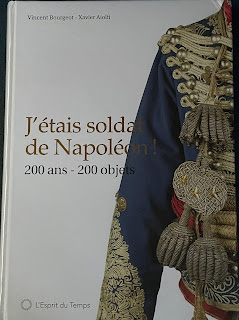
J'étais soldat de Napoléon!, the latest publication from Éditions Soixante, is a beautifully produced, lavish publication to round off the Napoleonic bicentennial. This hard-cover book, with its a gorgeously tactile, pseudo-leather wrap, 255 pages—heavy, glossy-stock—of exquisite, full-colour photographs is a collectors' edition at an affordable price. I pre-ordered my copy in October and took delivery last week. I have been drooling over it ever since!

Organised into 13 thematic chapters, each page is a photograph of an item of uniform, arms, equipment or other fascinating object from the soldiers of Napoleon's Grande Armée. Presentation of these 200 objects is grouped according to 'Napoléon et Bonaparte', 'Officers généreaux',  'Aides de camp', 'Service de sante', 'Infanterie de la Garde impériale', 'Cavalerie de la Garde impériale', 'Armes savantes Gardes impériale' (covering artillery, engineers, train), 'Infanterie de ligne', 'Cavalerie de ligne', 'Armes savantes de ligne' (from artillery, sappers, engineers), 'Troupes étrangères et corps spéciaux', 'Marine' and 'Demi-solde' (covering keep-sakes, mementos, the King of Rome's toy soldiers).

Many of these items will be familiar to readers from photographs in other books, on websites, or perhaps visits to the museums and collections in which they are held. What makes this so marvellous is the vast array of items that are gathered into one publication but, most importantly, the quality of the photography.

The photographs are so clear that you feel that you can almost touch the items; the worn shoes with their hob-nail soles, the texture of the shako badge, the braid on the dolman or the plume on the helmet. You could put on the coat and cuirass or roll the dice!

It is truly like having a museum in your own house (hands).

Also, being in book form, brings the items so much closer than the same photographs on the web.

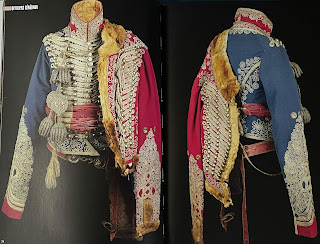
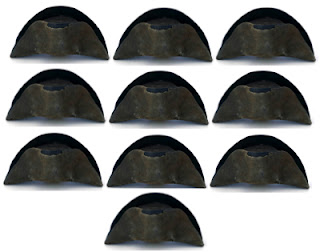
Just one of the photos of uniform items that are included; a dolman, pelisse and bicorne (shown on a separate page) of an officer of the light cavalry (from Musée de l'armée in Paris).

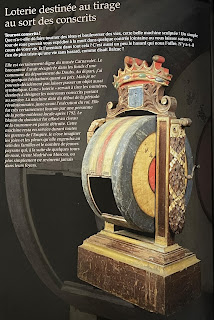
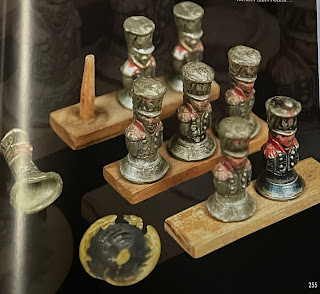
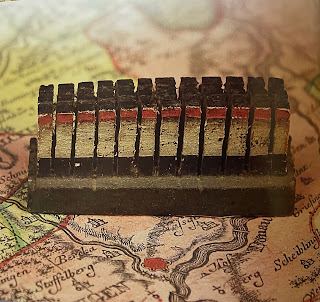
The items of uniform and equipment included in the book are numerous and truly magnificent, but it is some of the 'other items of interest' that really grabbed my attention on first looking through the book. The lottery for selecting conscripts, the dice used by soldiers in their games, the toy soldiers of the King of Rome and, a base representing 36 men, a planning piece used by Napoleon, at the camp of Boulogne in 1805, atop a map —the original Kriegsspiel!

Lottery to select conscripts. From Carnavalet Museum, Paris

Dice used by soldiers (from Ligny Museum).

Lead soldiers of the King of Rome. As the notes say, looking very much like tirailleurs of the guard in 1814-15 (from a private collection).

A block (base or unit in our terms!) representing 36 soldiers. As used by Napoleon in planning while at Boulogne. The inscription underneath, which is shown in a separate photo, reads 'This piece comes from a wargame made for Napoleon at the Camp of Boulogne and was used extensively to study manoeuvres' (my translation).

The text on each page briefly describes the object and then, in the first person, the object tells the reader a little about itself. Included (in the majority of cases, but unfortunately not all) is a note of the location/origin of the item. At the end of the book, a thematic table/glossary groups the items according to several categories: diverse souvenirs, awards and decorations, equipment of a soldier, items on campaign, kits and portfolios, boots and shoes, harness and saddlery, fanions and emblems, headress, portraits, drawings and prints, busts and statues, blade weapons, firearms, infantry equipment, cavalry equipment, badges, epaulettes, and, the largest category, uniforms.

This wonderful book has been nominated as the book of the month by la Fondation Napoléon. I am not surprised. It deserves to be book of the year.

Rating


Breakdown

    First impressions 10/10 (weighting 0.1)
    Presentation 10/10 (weighting 0.1)
    Content 10/10 (weighting 0.3)
    Supporting content—pictures, maps, appendices 10/10 (weighting 0.2)
    Sources 9/10 (weighting 0.2)—a few of these are missing
    Value for money 10/10 (weighting 0.1)

Total 9.8/10 rounds to 10!

Reference

Bourgeot, V and Aiolfi, X (2021) J'étais soldat de Napoléon! L'Esprit du Temps, Paris. 272 pp.